Unknown's avatar

Election Day

Election Day

Today is Election Day in Greece and, unless the polls are a greater waste of time than usual, the result will be a shallow victory for the center right party, Nea Demokratia, led by Antonis Samaris, which will gain the most seats in the Vouli (parliament) but not enough to form a government. Samaris has said repeatedly that he is not interested in a coalition government yet he will be given 3 days to form one. After that, the next two parties in the results rankings will be given 3 days each to form a coalition government. After that, there are a few elaborate and, dare I say, byzantine machinations to be completed before failure to form a government is declared and a new election is ordered. I have no idea how many times this could be repeated.

The people are angry and there is a lot of misinformation floating around the press and in the air. The last poll, conducted two weeks ago, indicated that as many as 10 of the 32 parties on the ballot could share power in the Vouli. Many of these are splinter parties, having broken off from the two main parties in the turmoil of the last 2 years, and a few are new, including the nightmarish Nazi party, Chrisi Avgi, or Golden Dawn. (Chrisi Avgi’s appeal is almost solely to anti-illegal immigrant sentiments, a chilling intensification of our own tea-bagging wing-nutery.)

This is the second election season I’ve spent in Greece and I’m jealous of Greeks in that they limit this lunacy to one month. The TV ad space is monopolized by back to back to back political ads and the news consists mostly of footage of speeches at political rallies but it’s tolerable when you know it’s only for a month. One of the huge benefits of our April-through-October schedule here is that we miss 6 months of the madness back in the States. Being here for elections also makes me wonder why we vote on Tuesdays. Wouldn’t Saturday or Sunday make more sense? Or are we trying to make it more difficult for working people to participate? Even this year, when refusing to vote is being used as a form of protest, the Greeks will likely have a much high turnout than we do. I wonder how much of that is attributable to our tradition of voting on a workday.

The voting in Sikya is taking place in a building on the beach that looks like a traditional house but appears to be used for little more than voting. Most Greeks vote in schools and, this being Greece, the nation’s schools are closed Friday and Monday so that the polling places can be prepared and then removed. When a person enters the polling place, he/she is given 29 sheets of paper and an envelope. The voter marks the sheet for the party he/she favors and puts it in the envelope. The other 28 sheets are recycled. Voter registration is 9.8 million. There are 6,300-some individuals up for election today. And somewhere in Greece there is a very happy, and likely very tired, printer.

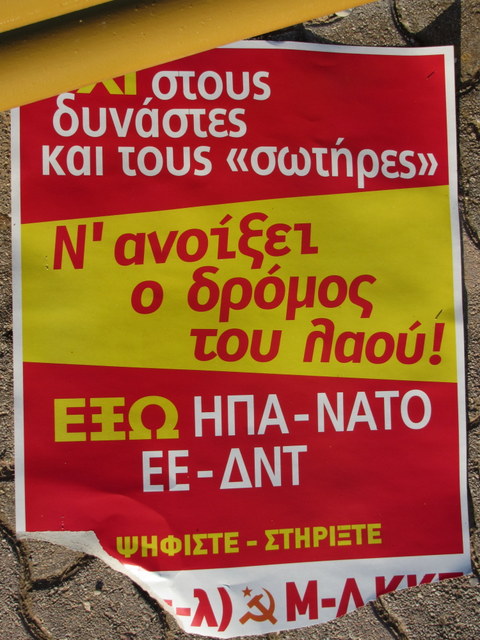
The photo is of a poster for the Greek communist party. Having grown up in the States in the 50s, seeing communists openly politicking is a bit like running into the spawn of satan at Macy’s. When I see their rallies on TV, I still marvel that they look like regular people. In the 2008 election, the KKE got 3% of the vote — this time, they are projected to get 10%. The anger that has propelled some people to the far right has also fed the growth of the far left. These posters went up overnight on every lightpost in Sikya but before I could get out with my camera the next day, someone had ripped every one of them down. The communist guerrillas in Greece during WWII and the civil war that followed committed terrible atrocities against their countrymen, and there are obviously strong feelings about it still. The KKE is unrepentant, however, spouting lines so old and tired they sound like a B movie script. As a policy, they reject every law and regulation passed by the European Union, and they have already announced that they will not support the winner of today’s election, regardless of which party it is. The poster reads in part, “Out USA – NATO – EU – IMF” even though the US left long ago, with the exception of a navy base on Crete and the embassy in Athens.

The nerve-wracking part of this election cycle, however, is not who will win today but how the likely deadlock will be resolved in the days and weeks that follow. The interim government leaked a list of 77 items that the new government must complete in a month’s time to fulfill the requirements of the last financial aid package, and the very real possibility of a political stalemate makes it unlikely that any of them will be accomplished.
Unknown's avatar

A Trip to Athens

A Trip to Athens

We went into Athens on Thursday to conduct a little bank business but we also had time to stop by our favorite bookstore, visit the Poet Sandalmaker for a new belt, have lunch at our can’t-miss kebab taverna, and chill at a hidden cafe in one the busiest parts of the city.

After sleepy Sikya (pop. 231), Athens (pop. 3,000,000) is a punch in the nose. Loud, crowded, dirty, graffiti-vandalized, and swarming with illegal immigrants selling bootlegs and knockoffs, Athens is a city that gives no quarter. It takes awhile to begin seeing beyond the affront to the senses but once that happens and the layers start peeling back, Athens is an opera. The whole range of human emotions has been carved into this city and the scars are now more than 2,500 years deep. You can walk where Socrates walked. You can visit the hillside where people first voted on the laws that governed them. You can stand on the rock where St. Paul defended himself against charges of sedition for preaching Christianity. And you can touch the flagpole from which the Nazis raised their flag over the Acropolis.

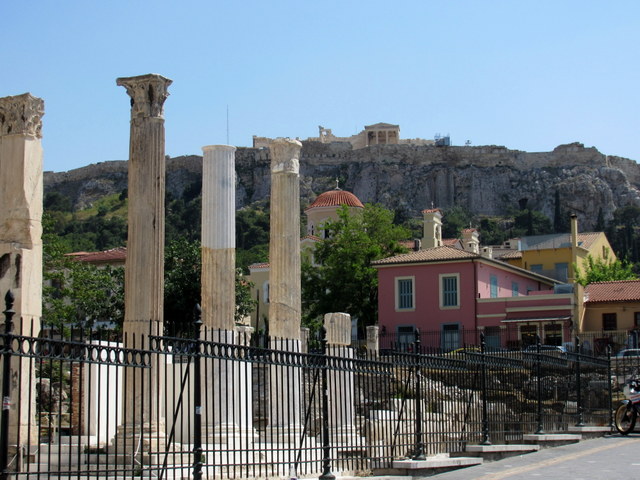
The Acropolis dominates the center city. Leaving Monistiraki Square, we see the the pillars of the Library of Hadrian in the foreground, with the Acropolis towering above. The structure we can see on the Acropolis is the Erechtheion. This temple marks the spot where Athena and Poseidon battled for patronage of the city. Poseidon struck the rock with his trident and a salt water spring erupted from the stone. Athena struck the rock with her staff, and an olive tree grew. The city was awarded to Athena, and this temple protected both the spring of Poseidon and Athena’s olive tree.

Unknown's avatar

One of the great pleasures of Athens is looking up a cross street at an intersection and seeing something like this. It always makes my heart leap. On the right, the walls of the Library of Hadrian. In the center, the Tower of the Winds in the Roman Agora. Above, the Acropolis with part of the Erechtheion visible.

Unknown's avatar

Adrianou Street. Bordering the Ancient Agora on the right, and lined with tavernas on the left, Adrianou is one of the busiest places in Athens — we caught it here during siesta time on a light day.

Unknown's avatar

IMG_0527

The Stoa of Attalos. Reconstructed by the American School of Classical Studies in the 50’s this ancient version of the shopping center anchors the Ancient Agora at the foot of the Acropolis. It now houses the museum of the Agora. The Acropolis is just visible above the roofline, with part of the Propylaea (grand entrance) rising above the walls.

Our word Stoic derives from a group of philosophers that met in one of Athens’ stoas.

Unknown's avatar

IMG_0522

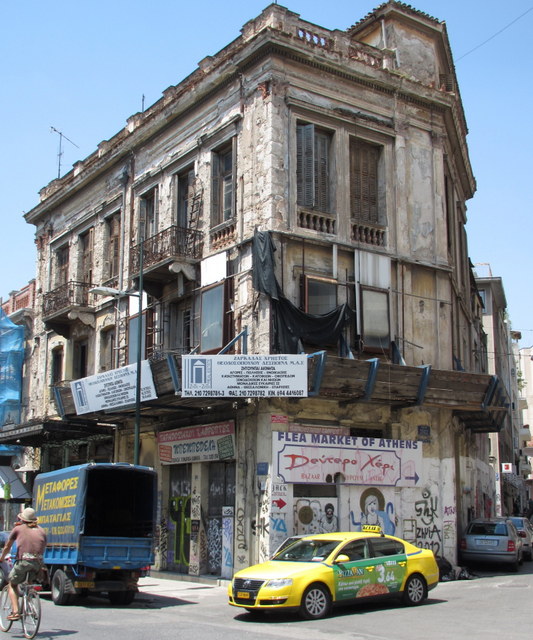
A neoclassical house on Ermou Street. In the early 20th century Athens had developed into a beautiful city that was being compared to Paris. In 1923, the Great Powers, in order to stop the fighting between Greeks and Turks, ordered all Christians in Turkey to go to Greece, and all Muslims in Greece to go to Turkey. Athens’ population tripled almost overnight and the city, in order to provide shelter for the refugees, allowed/encouraged the neoclassical mansions to be replaced by the small, anonymous apartment blocks that dominate it today. This old timer escaped the destruction of 1923 but has fallen into terrible shape; the wooden “girdle” is to protect pedestrians from falling stone in the event of an earthquake.

Unknown's avatar

IMG_0520

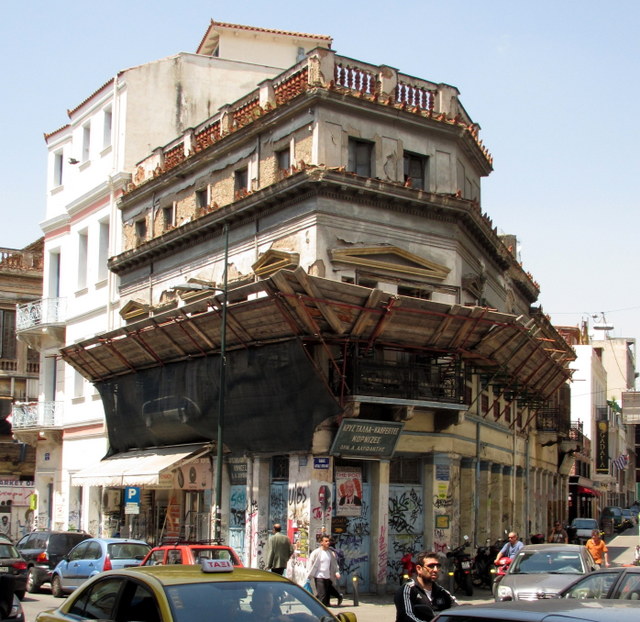
Another neoclassical house on Ermou Street. I photograph these because, while I hope their destruction is prohibited, I can’t see how they can ever be restored, and I expect they’ll all be replaced by the soulless bauhaus crap that monopolizes the city today.

Unknown's avatar

May Day

May Day

As far as I can tell there are no US-style parades here on May 1 and no gratuitous speech-giving about the nobility of work. The communist union held a demonstration at a business they’ve been striking for 6 months but that was it. Mostly folks did what we do on Labor Day — throw some meat on the grill and eat outside. People in the next building put a whole (small) hog on a spit and roasted it in the parking lot. The Gulf’s water is still cool but the air is warm, so there were a few family groups on the beach, with the kids playing in the shallows. It’s also a tradition here to go into the countryside and collect wildflowers on Protomayio. We supported this by denuding the hills above Sikia and coming home to arrange wildflowers in a honey-jar vase, and construct a fairly troubled-looking wildflower wreath. Warm weather and holiday meals: it’s beginning to feel a lot like summer.

Unknown's avatar

ψωμί

ψωμί

Greece has a lot of problems but bread (psomi) isn’t one of them. This lovely half-kilo (1.1 lb) loaf of ciabatta came from a bakery in Kiato, a town about 5 miles east of here. Bread is price-controlled, and this loaf cost us .80 euro. We buy one every other day. Every village has at least one bread bakery, called a fourno, or oven. Ours is about 200 yards down the road. Towns and larger villages have more than one fourno, so one or more of them usually expand into sweet shops, which make and sell cakes, baklava, cookies, etc. The regular fournos usually sell savory snacks that folks eat mid morning in lieu of breakfast — mainly cheese and ham-and-cheese puff pastries.

In the old days, the fourno served as the village oven. Meals to be roasted were prepared at home and carried to the fourno where the baker would oversee the cooking for a few drachmas. Someone went back to the fourno at the appointed hour and brought the cooked dish home. You may be certain that this running to-and-fro was invariably accomplished by women and girls. I saw a rare instance of this ancient practice in a bakery in Xylokastro, the town on our western border. As I was waiting in line, the baker carried an enormous round pan of stuffed peppers and tomatoes from the back of the store and handed it to the woman in front of me. When I left the shop, she was carrying the pan down the road, stepping carefully I’m sure. I don’t know whether the pan wouldn’t fit in her oven or whether she didn’t want to heat up the house, but she knew exactly how to solve the problem.

We were surprised to find that Greece (this part of it, anyway) doesn’t have regional bread styles. Every fourno seems to bake a different kind of bread. In this village, the bread is fine-textured, white, and good for sandwiches. We like more rustic, crusty bread and the two bakeries we visit in Xylokastro fit that bill, including one that offers brown bread. We usually travel to Kiato because the oven is wood-fired and because…well, because it’s ciabatta! Kiato also enjoys the trade of a sensational sweet shop. We avert our eyes when we pass it on the road but man, oh man, what a way to pack on pounds.

Unknown's avatar

Korinthia

Korinthia

We live in Korinthia, a prefecture that includes half of the southern coast of the Gulf of Corinth — about 40 miles of coastline. The strip along the shore is what most visitors see — Korinthos itself is a port city, and just to the east is the spa town of Loutraki. The highways to the west run right along the coast. The villages that string along the highway, including ours, are a procession of summer resorts. But south of this thin strip — the entire interior of the prefecture — is agricultural. Grapes are the primary product here. Not only the awesome red wine grapes (agiorgitiko) for which this region is (nationally, soon-to-be internationally) famous but also table grapes and, wonderfully, raisins. Driving the mountain villages in the fall, one sees raisins drying outside under sunscreens. Fresh raisins are sensational; the leathery version we get in the Dole boxes give just a hint. Citrus is also a major crop, oranges and lemons. Fresh squeezed OJ is simply expected here but, oddly, I’ve never seen a lime in this country, which puts a real crimp on my gin-and-tonics. Olives, of course, are ubiquitous. And there are vegetables. The area is mostly mountainous but the limited flatlands produce tomatoes, cukes, melons, zucchini, string beans, and all of the other stuff we grow in our home gardens in the mid-Atlantic. What seems strange to me, with my own definitions of agriculture, is that there are no field crops in Korinthia. No corn, no wheat, no soybeans, no hay. Seems strange that there is an entire agricultural region without any of that stuff. Those crops are grown in the flat heartlands to the north of us but here it’s mostly crops that can be grown on hillsides.

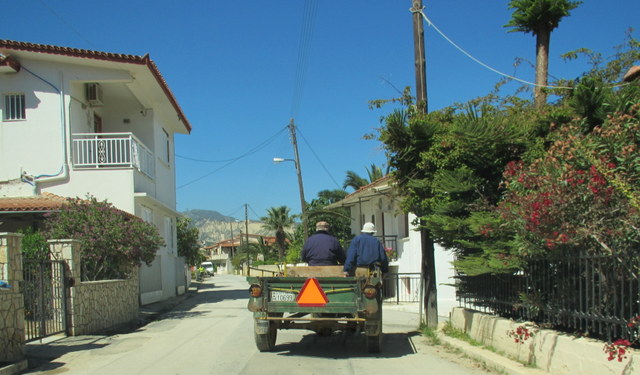
Susan shot this photo through the windshield as we were winding our way (very slowly) to the butcher shop in Melissi. It is a walk-behind tractor pulling a cart. Ma and Pa are sitting in the cart, steering and operating the hand controls to prevent mayhem. These rigs drive the Old National Road (Greece’s Route 1) past our apartment occasionally and I love seeing them. It’s a refreshing change from the Athenians crushing all in the the paths of their Mercedes’ on the way to their beach houses. We see more of the farm trucks, usually small Japanese pickups with “Agrotiko” painted on the sides — the equivalent of our “farm use only” — than these tractor-and-cart rigs. But they all have in common some of the sweetest, most modest, hardest working, unpretentious, most comfortable-in-their-own-skin folks you would ever want to meet. And they’re always ancient. I guess it takes the self-confidence that comes with age to pilot one of these along roads terrorized by Ducatis and wonder-wagons.