We took a trip across to Ionian and Adriatic seas to visit Bologna, and came home with with some sort of upper respiratory crud that we shared the last few weeks. I don’t have a lot of Greece photos to post but there are a few that I like.
I’ve been trying to get this photo for almost 25 years. I was shooting out the window as we took off, and was amazed to see landmarks I recognized. Eventually I got to where I wanted. But don’t look too close – I was zoomed out and the airplane window was filthy.
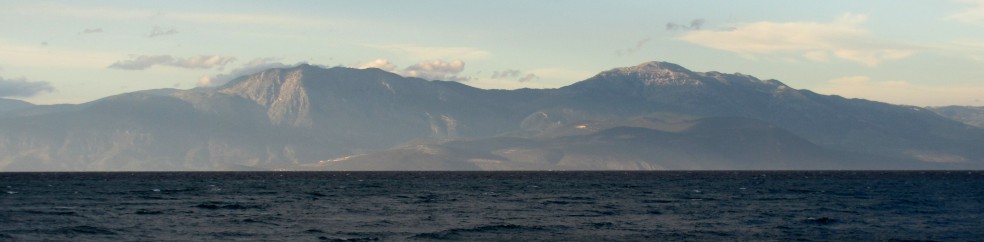
I guess the gods were with me – I spotted Mt. Olympus on the way home. This is another one I’d wanted for decades.
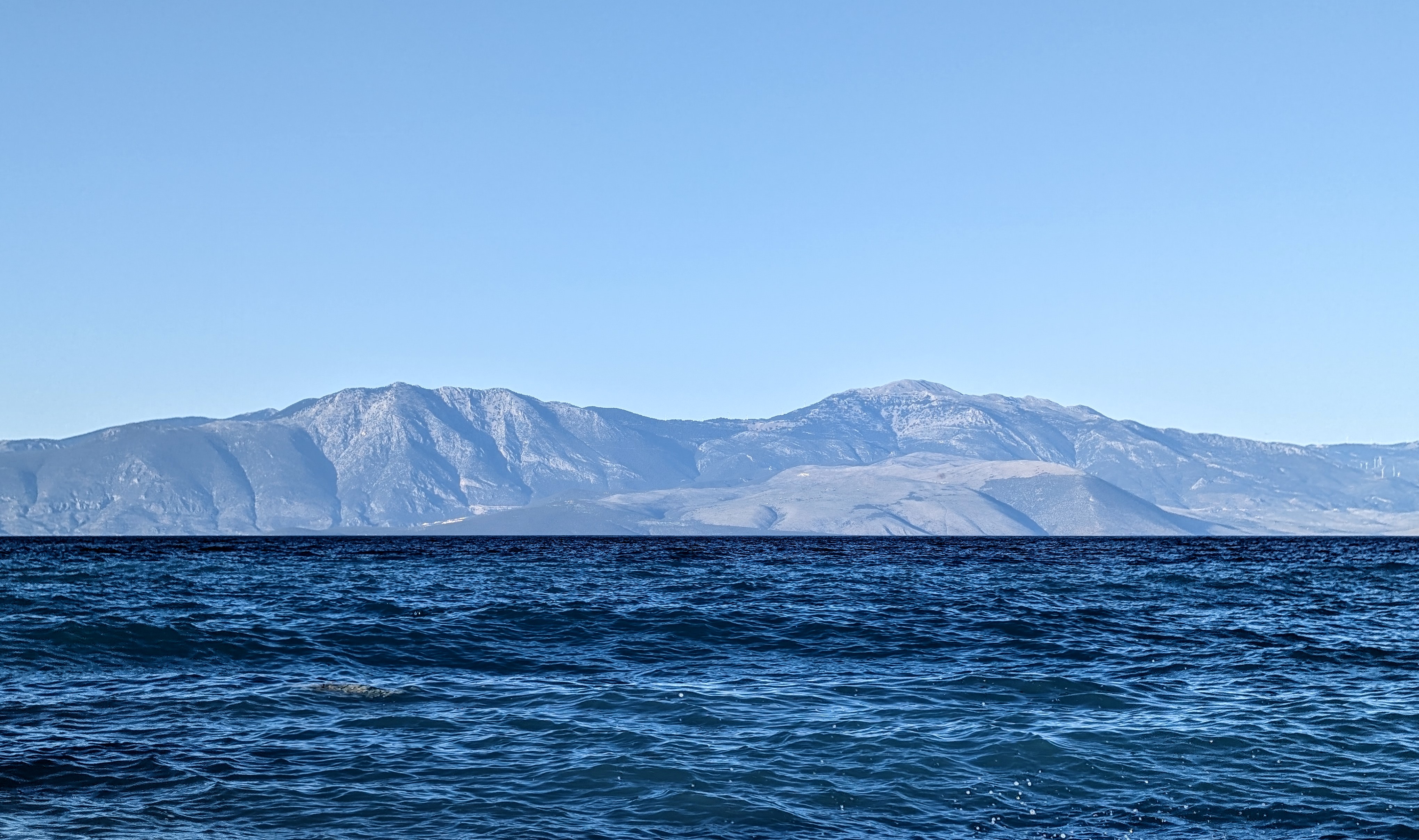
And finally, my favorite landscape: the beach, the sea, the mountains, and the sky from Sykia.
This time of year dust that rises from the Sahara desert into the atmosphere can be blown north, across the Mediterranean, and into southern – sometimes northern – Europe. This year we’ve seen our share, some days heavier than others but when we have a north wind the dust blows away and the sea and the mountains stand out in sharp relief.
The size of the mountains and the clarity of the air makes them seem closer than they are — it’s 11 miles to the nearest shore and 13 miles to the peak of the mountain.
This is the house of the last Ottoman bey, Kamil Bey. After Greek Independence in the 1820s it became the property of the Greek state, which has practiced benign neglect ever since. With the roof now gone, it won’t be long until the walls start to crumble.
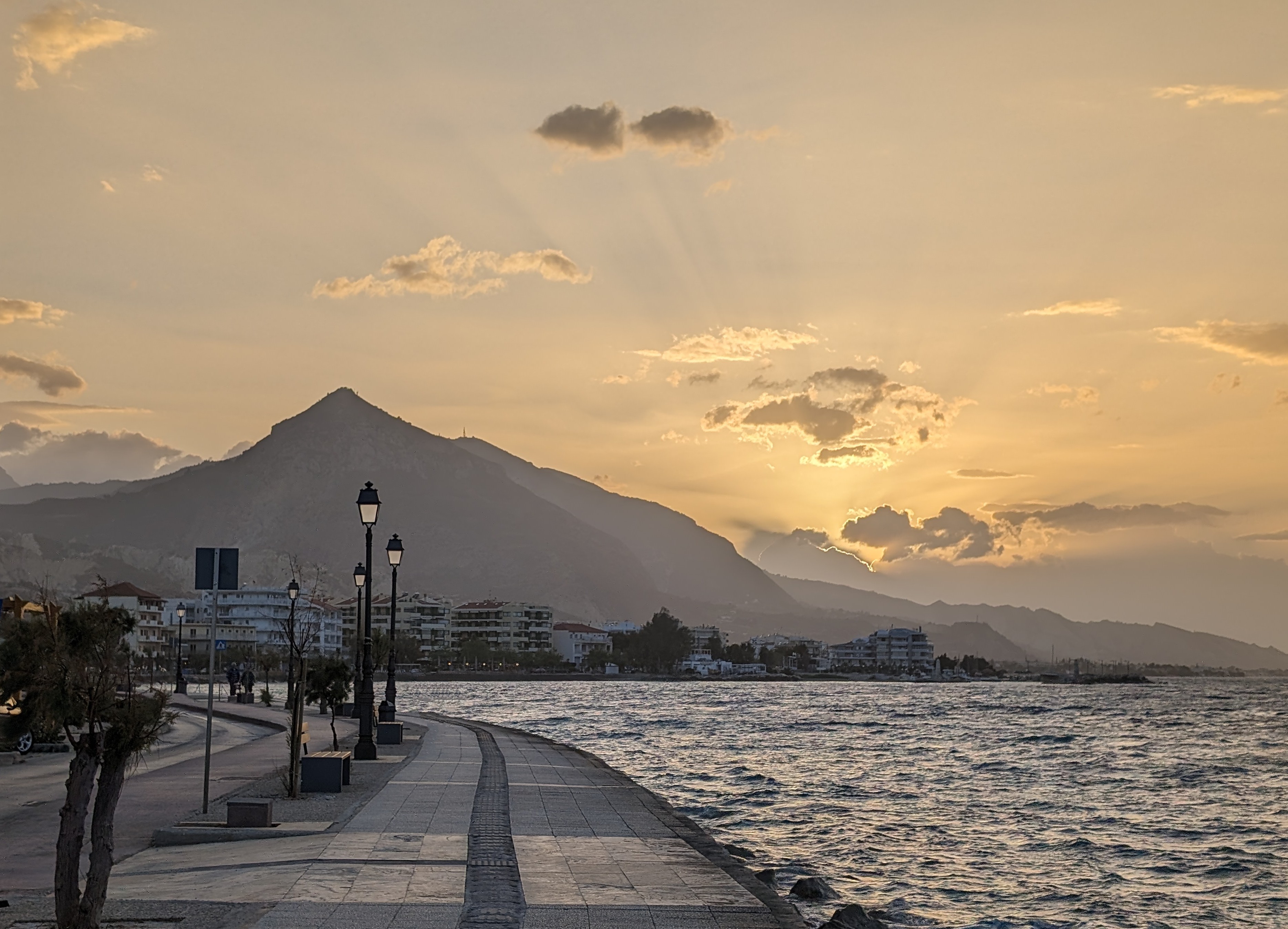
Sunset tonight. The mountain rises to 2400 feet, and there is a convent on top dedicated to the Virgin Mary. It’s not known when the convent was founded but the church dates to 1767. On the Virgin’s feast day, pilgrims walk up to the convent.
The Little Owl or Athena Owl is a revered symbol of Greece that we only see in Mani. And it really is little – usually 9 in. or less. Apologies for the photo – she was sitting as far from me as she could, and I had to extend my phone’s digital zoom to 30X.
We took a walk around our village – Sykia – yesterday.
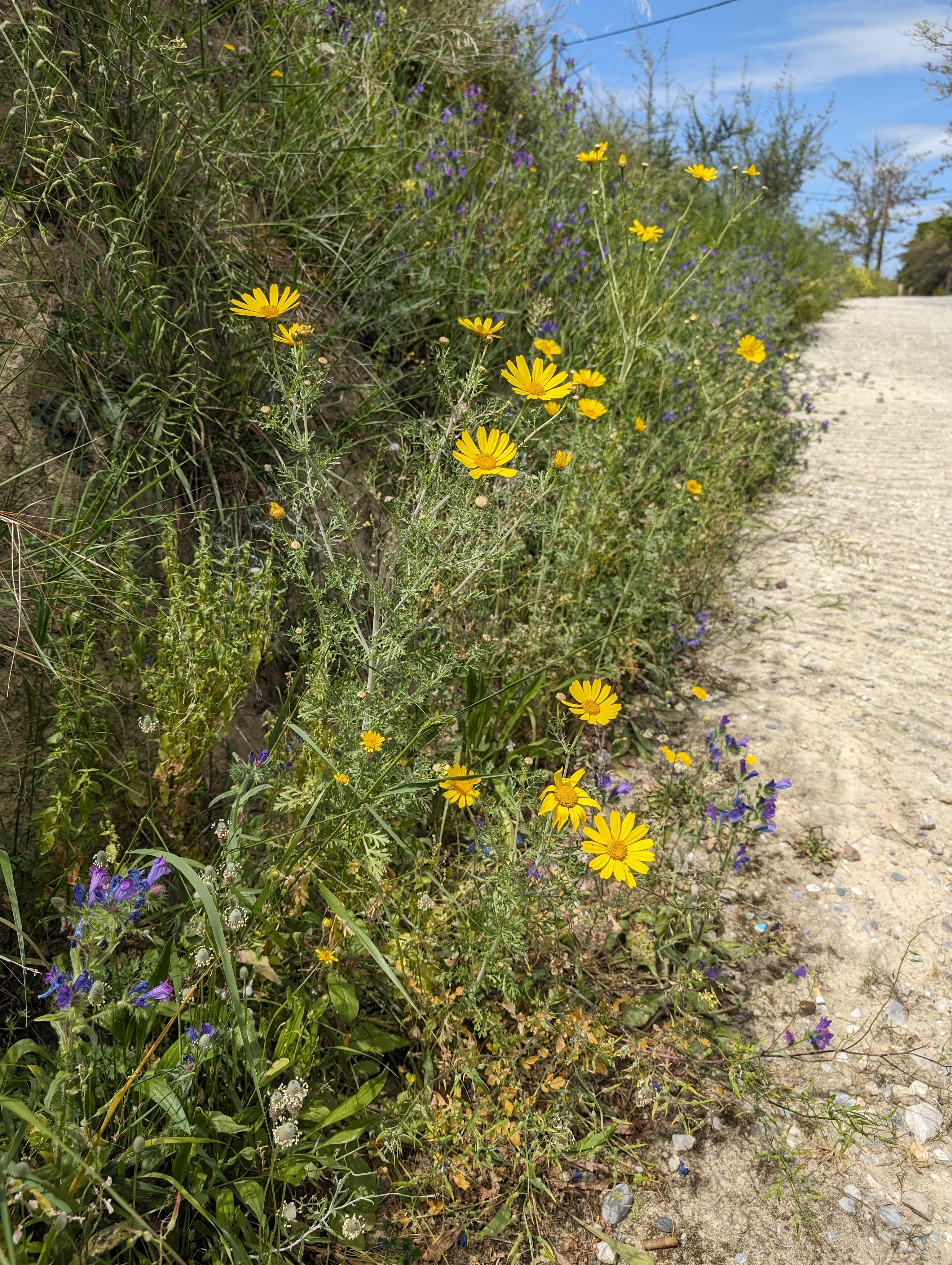
There’s a tremendous profusion of wildflowers in early Spring, with native vegetation taking advantage of cooler weather and moisture in the soil.
The train stopped running through Sykia in 2008, and the tracksides now present wildflowers a place to strut their stuff.
We’re missing the Redbuds in the mountains this year, so we’ve taken to calling these trees Redbuds. Google identifies them as Judas trees.
They can flower directly from the trunk.
Orange blossom. Just as one crop is falling from the trees, another is getting started. There are two crops of oranges and lemons each year.
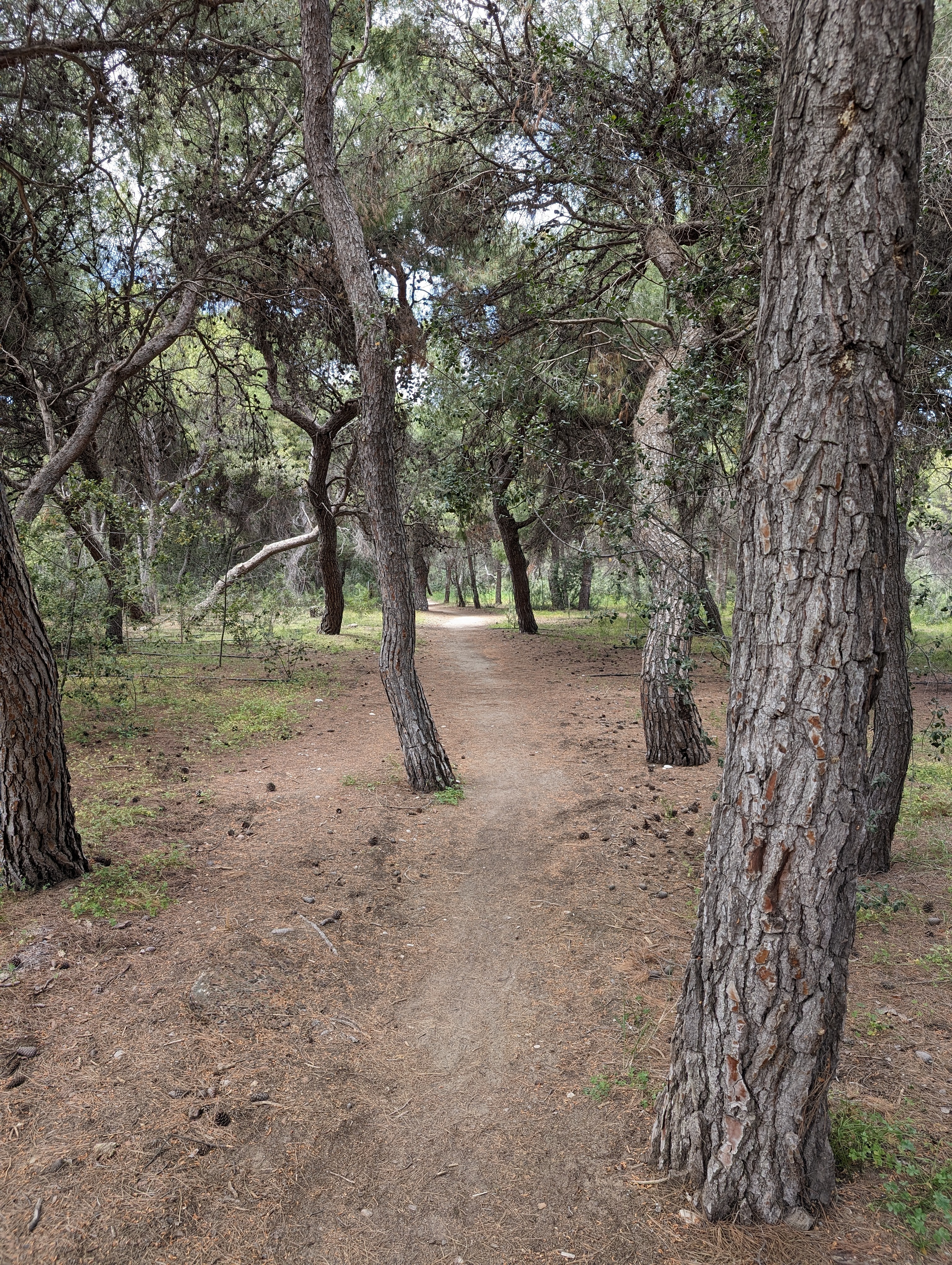
Walking on pine needles.
This summer, kids and grownups will be playing on the water in these boats. In the spring, they provide a backdrop for the wildflowers pushing through the beach pebbles.
We made a trip to the Skouras winery for essentials and saw early Spring manifest.
When you see new life emerging from a weathered, withered, twisted lump of wood, it’s easy to understand the ancients’ belief that divine intervention was involved.
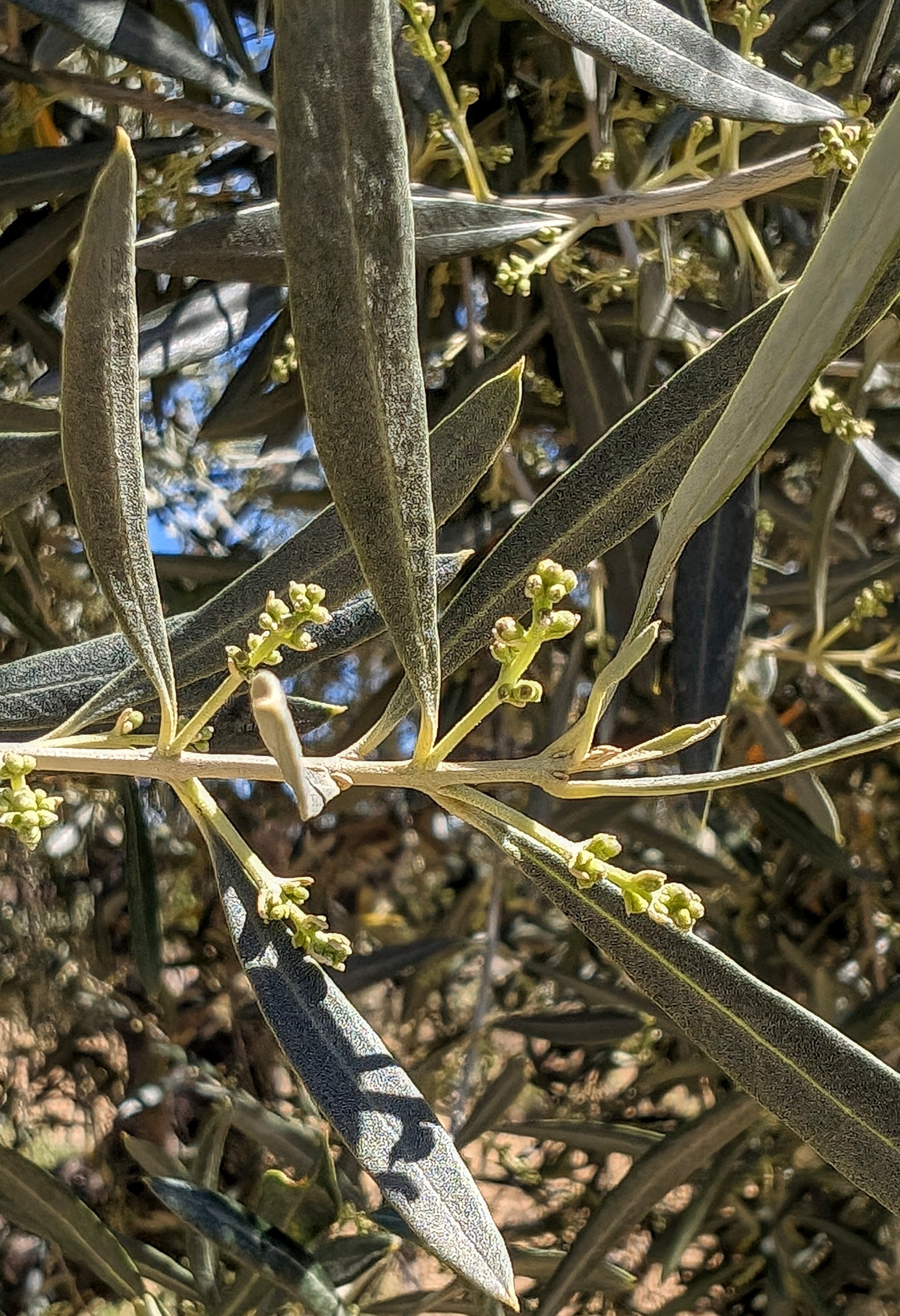
These are the buds on an olive tree. Almost impossibly tiny, each could be hidden behind the head of a pin.
It’s been fully five years since I posted here, and I’m not sure how to pick up the thread so I’m just posting some photos from our 89 days in Greece this year. In the intervening five years, we celebrated the 15th anniversary of our move-in; the date was October 24 last year, and we were here to pop a cork. (On October 24, 2007, we slept on a mattress on the floor, and were awakened the next morning by church bells so loud and jarring that we thought it was a tsunami or earthquake warning.) We missed an entire year due to COVID. And we witnessed the continuing commercialization of Sykia. But that’s for another post on another day. Probably another year.
A boardwalk was added to part of the beach a couple of years ago. In spring, wildflowers adorn the beach.
A two-masted sailboat moored in our bay overnight. Nice choice.
Artsy shot of wild capers growing on the beach. Old timers still collect and brine them. But not these old timers.
Sykia beach in spring.
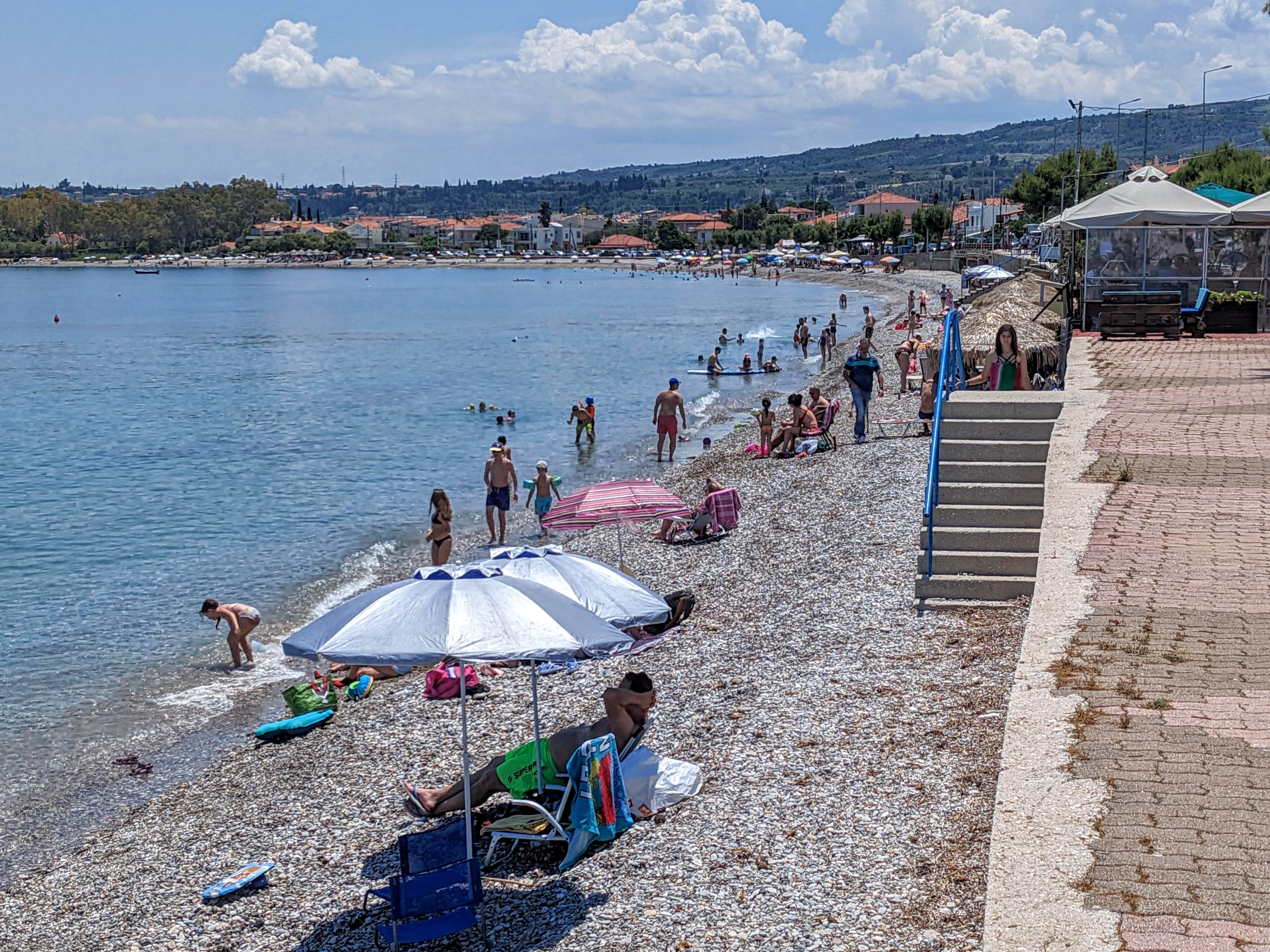
Sykia beach in summer. Can you guess which one I prefer?
We were fortunate enough to visit Crete this time. Our last visit was in 1972. This is part of the Venetian harbor in Heraklion, the major city. The tunnels in the center are shipsheds built by the Venetians between the 15th and the 17 centuries. Originally, 19 of these sheds lined the waterfront.
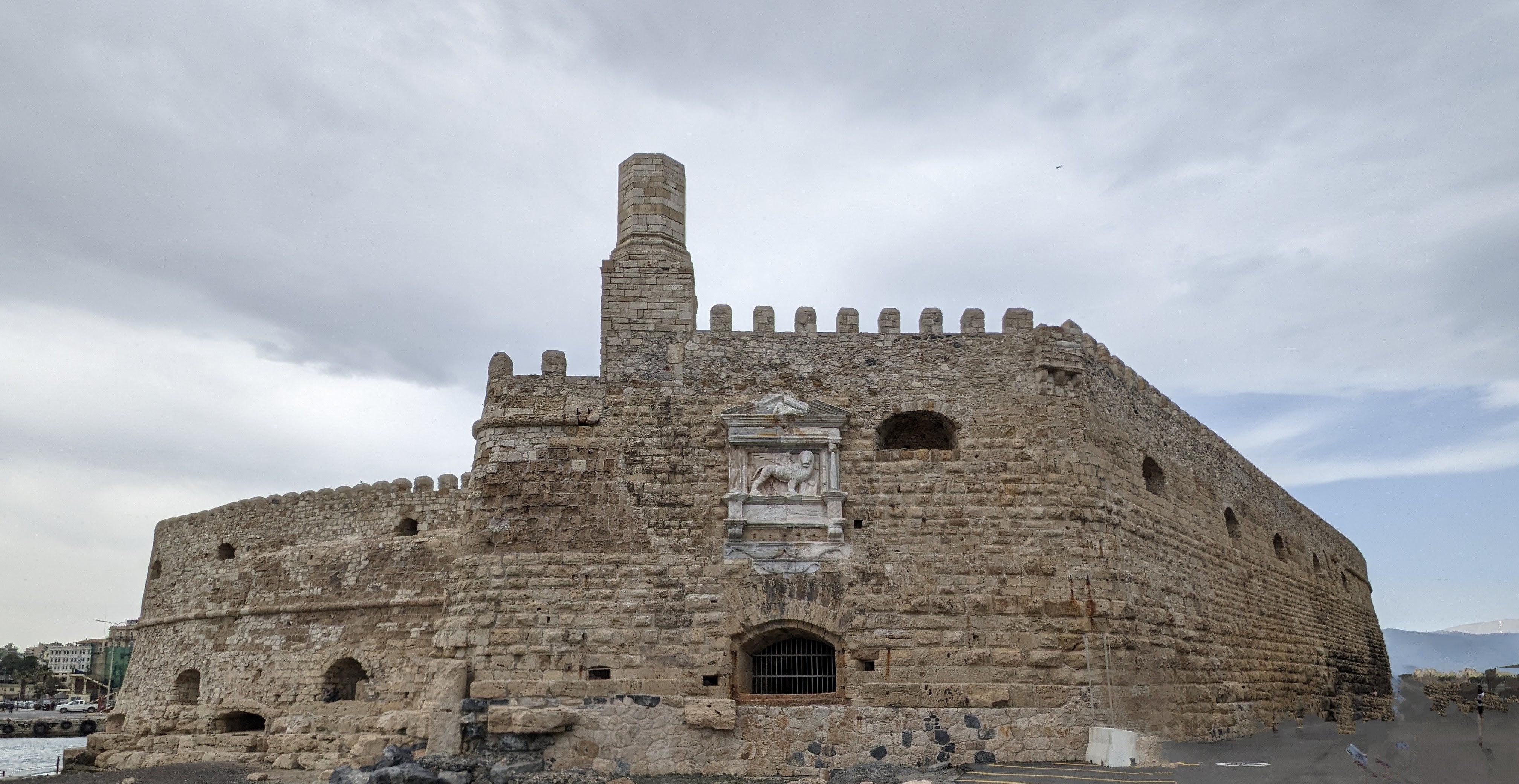
The Venetian harbor in Heraklion has a great, brooding fortress along the seawall to protect the entrance. This is Rocca a Mare fortress, built in the 16th century.
It’s a nice fort to visit, with several displays conveying the reality of life inside. Here is a store of amphorae, likely used for oil and wine.
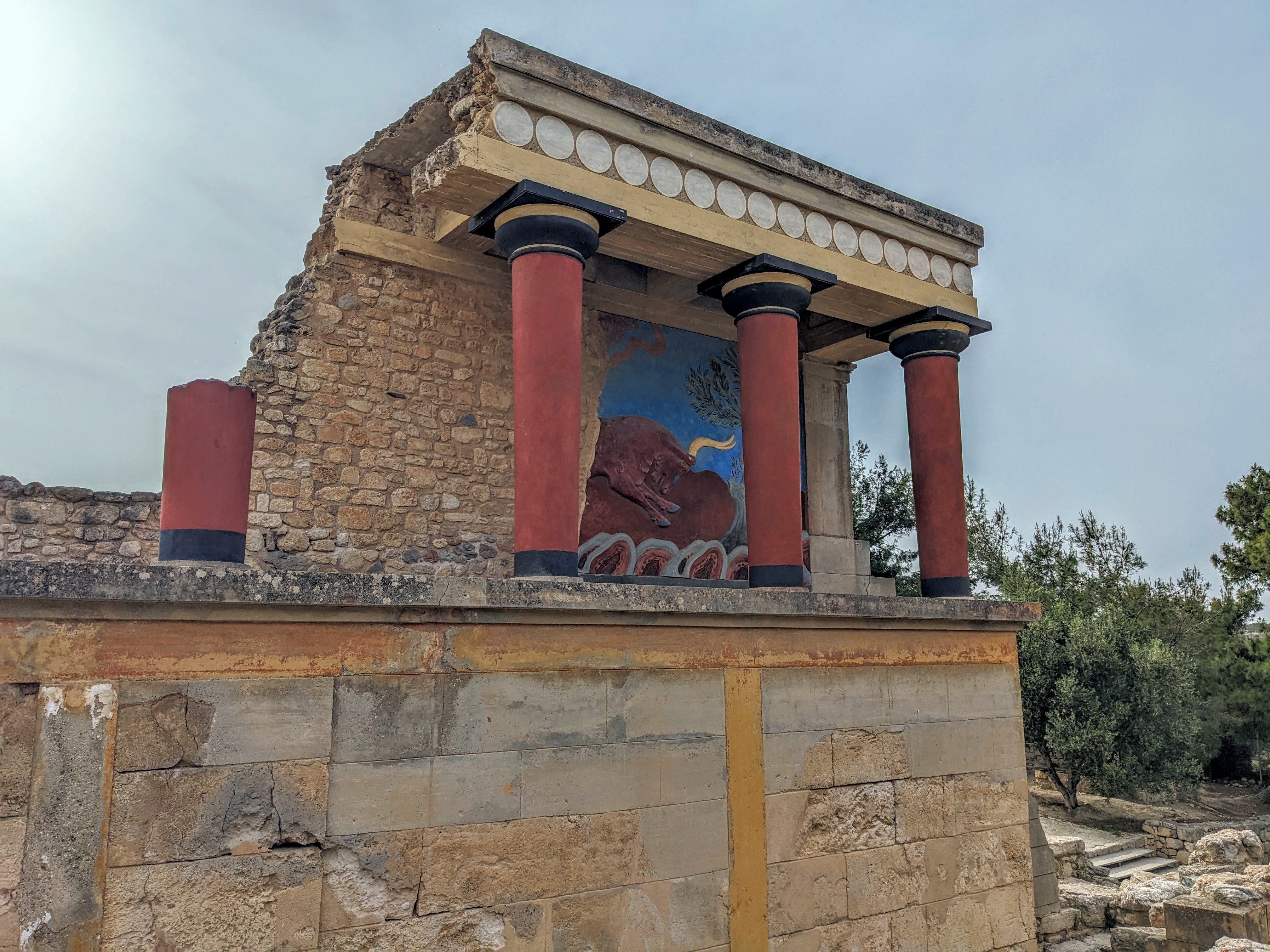
The star of the show in Heraklion is the nearby ruin of the palace of Knossos. Some details such as this have been imaginatively restored to give an impression of the grandeur that once awed the subjects of the kingdom. By legend, the Minotaur, a beast with the head of a bull and body of man, was kept in an elaborate labyrinth under this palace. The palace was constructed circa 1600 BC, making it more than 1200 years older than the classical-era Parthenon of Athens.
The palace is estimated to have covered three acres.
The throne room at Knossos. Minos was the legendary king of Knossos, and gives his name to the Minoan civilization.
Heraklion has a fine, extensive archeology museum that displays objects found during the excavation of Knossos, including this bull’s head, and the dolphin fresco below.
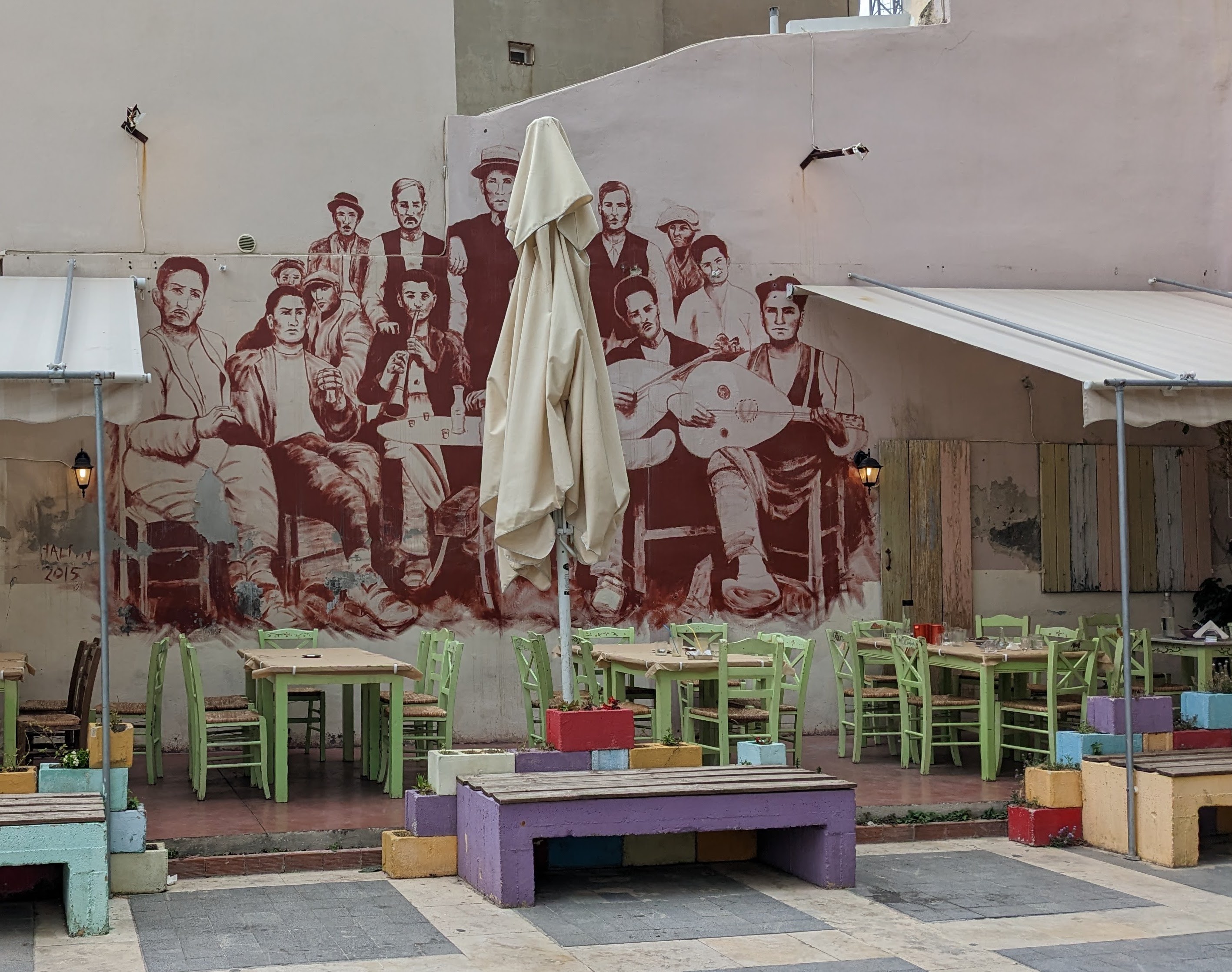
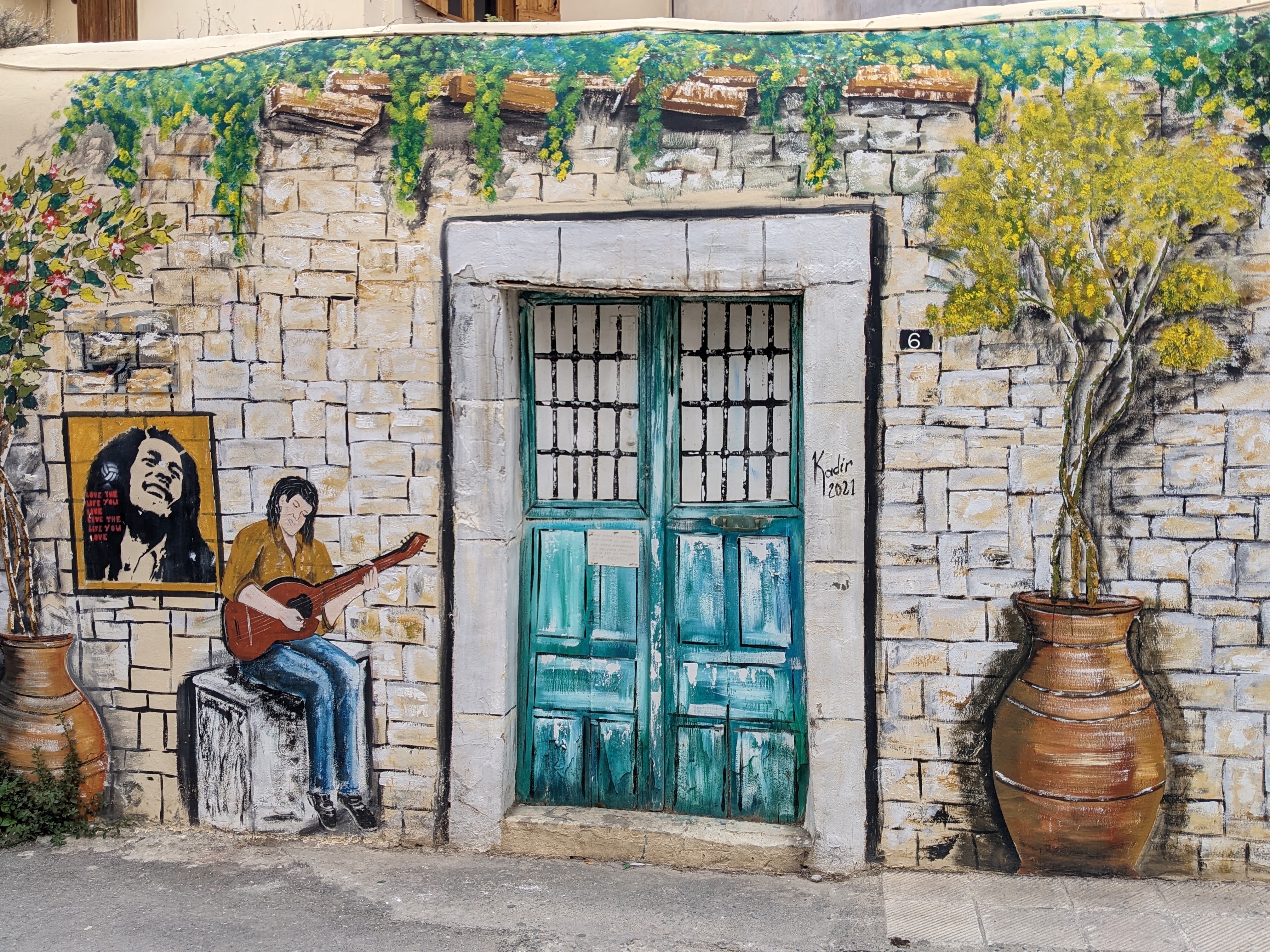
Three murals in Heraklion.
Heraklion city hall.
Leaving Heraklion, we detoured to see Matala beach on the south shore. This very fine beach is where in the ’60s an international community of young people (most famously perhaps, Joni Mitchell) took up residence in cliff-face caves on the right (out of sight here). The caves are thought to have been dug by Romans or early Christians for use as tombs.
About an hour west of Heraklion is Rethymno, probably Crete’s second city. It, too, has a very fine Venetian port. Rethymno’s port also has a massive Venetian fort built on a bluff on the headlands.
A gate in one of the few remaining sections of Rethymno’s city walls.
About an hour west of Rethymno is Chania. We visited my brother in Chania in 1972, when he was stationed at the Navy base nearby. One of my fondest memories of that trip is the old Venetian port, where we sat drinking the night away 50 years ago. I was desperate to see the port again but, unfortunately, this is where COVID caught up to me. I was too sick to do anything but walk to the port and take this photo, after which we pulled the plug on the trip, and headed back to the airport.
With patience and OTC pharmaceuticals, we managed to pull each other through COVID, marveling each day at how much sicker we’d been the previous day. At any rate, two weeks later we were back to rude good health, and decided to proceed with a trip to Ikaria that we’d planned months in advance. Ikaria is an island in the east-central Aegean, renowned for the longevity of its inhabitants. The “secret” of their long lives is actually quite well known – a diet of predominantly vegetables and fruit, with the occasional fish and virtually no meat. A factor almost as significant, however, is their super-low-stress lifestyle. I’m pleased to report that includes a glass of wine with meals, as well as a measured pace and an indifference to clock time. We stayed in the island’s capital, Agios Kirikos, and often found ourselves in the taverna at the base of these stairs.
After Ikaria we were able to visit the southern-most part of mainland Greece, the Mani peninsula. Mani is wild and rough. It’s the place Susan’s grandfather emigrated from in 1910. These are views out our room windows.
This was the view from the terrace of our room, looking south down the west coast of Mani. That far cape is the Cavo Grosso, and it is indeed large – those cliffs rise as much as 600 feet above the sea. The cliffs are riddled with caves that pirates used as hideouts right up until Greek Independence. Ships sailing south from Kalamata, as well as western European shipping bound for Athens and points east, were fair game.
Aeropolis is the de facto “capital” of Mani. Under Ottoman rule, it was known as Tsimova but when the war of independence started, it was renamed for the ancient Greek god of war, Ares (known as Mars in Roman mythology). This the church of the Archangels, and it was from this church that the revolution started on March 17, 1821. Maniots immediately marched on the Ottoman garrison at Kalamata, overrunning it. Thus Maniots had been in the field 8 days by the official start of the war on March 25. Independence Day is celebrated on March 25 (the feast of the Ascension) in the rest of Greece but in Mani the parades, speeches, and fireworks all happen on the 17th.
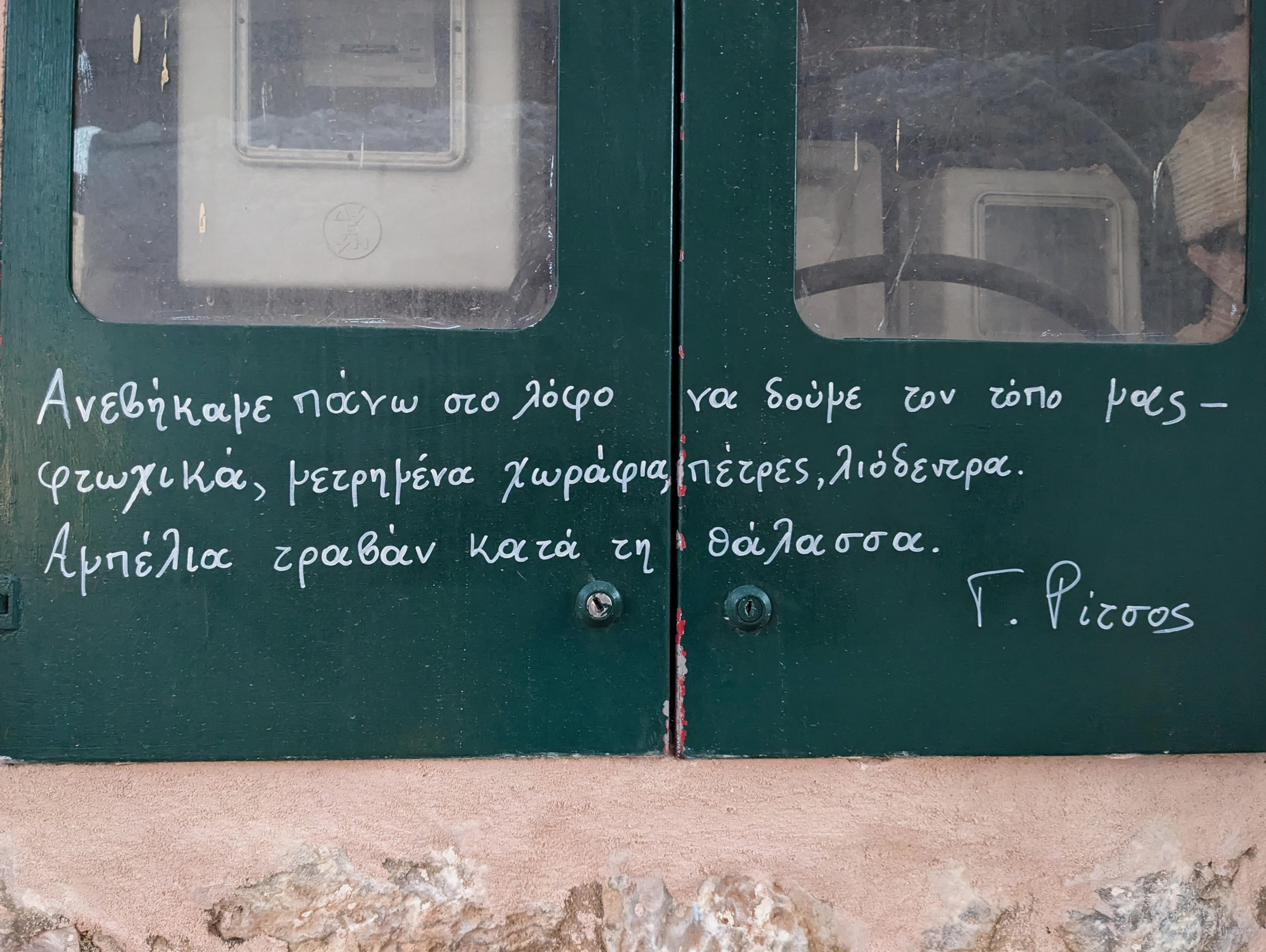
Sitting with family at a cafe in Aeropolis, I couldn’t help but notice this fragment of a poem by Yiannis Ritsos written on the box for the cafe’s power meters. Ritsos is one of the great Greek poets of the 20th century. These are the first few lines of his poem, Our Country, loosely translated as :
The ruins of a monastery church on the seaside in Limeni.
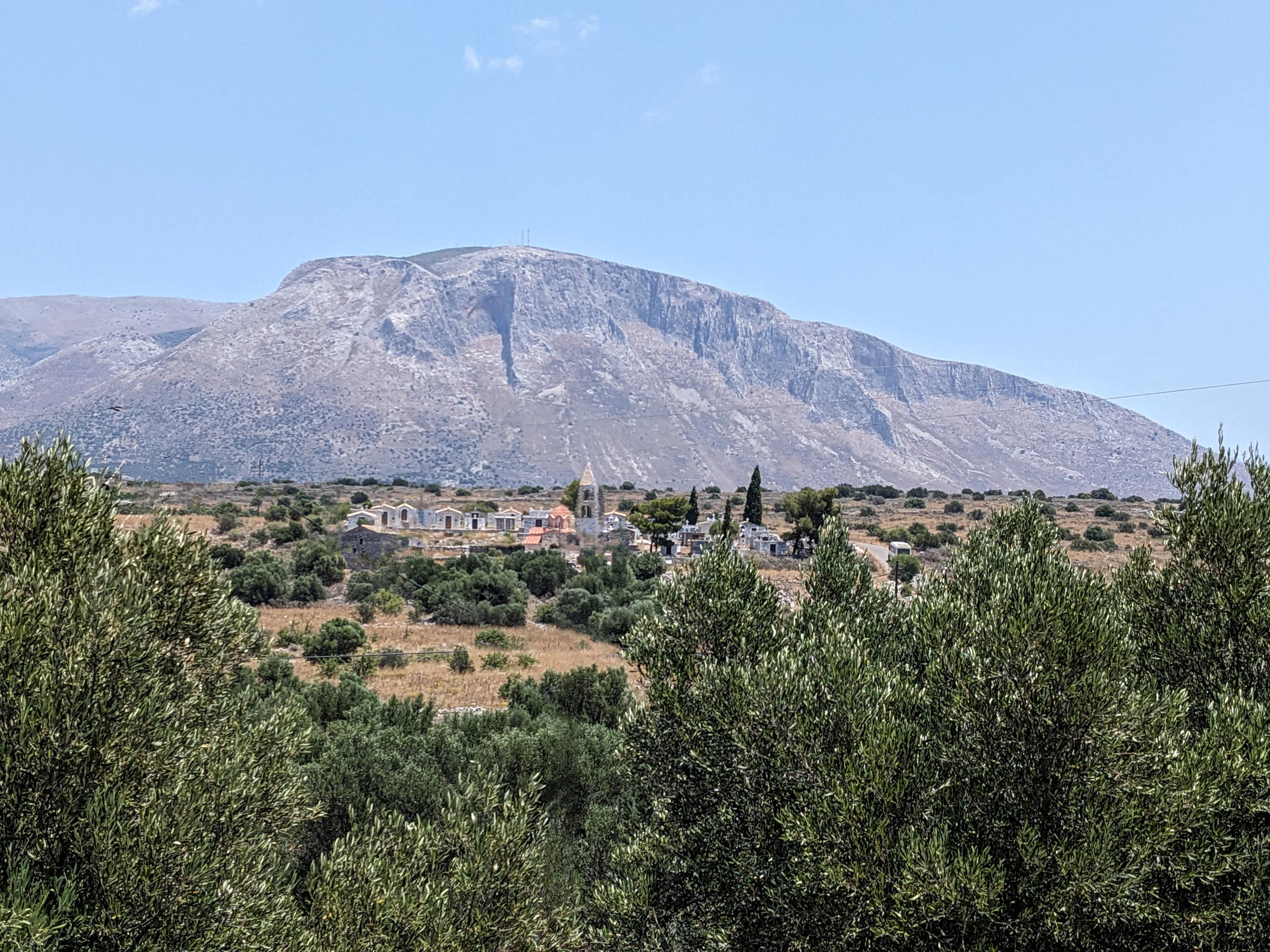
When I first spotted this church, I thought it was surrounded by the buildings of a small village. In fact it’s a cemetery, and those are mausoleums. Originally this was a monastery — all that remains is the church, and mausoleums have been built in the footprint of the monastery buildings.
Mani. The real Mani.
There are many churches in Mani. This is one of the oldest intact churches that I know. It is St. Nicholas, and dates from the 11th century. It is on the road between villages and, like most Mani churches, is always locked.
On the other side of the peninsula, however, we found a church that is left open. This is the church of Our Lady in the small village of Ochia. It’s about the same vintage as St. Nicholas, I’d guess. There are a few frescos remaining on the upper left of the iconostasis. The altar is through the opening. The bottles on the floor are filled with oil for the lamps. They may be offerings but this church is obviously being tended. It is unique in my experience because it is twinned with another still smaller and older church called St. Peter’s. The entrance is through a small opening on the left wall.
The view northeast from St. Nicholas.
Last church but this one is special for it was here that Susan’s great-grandfather was a priest. This is St. Nicholas in the small Mani village of Kounos. There are two active churches in Kounos – St. John’s has been restored, and St. Nicholas is waiting its turn. This one is remarkable for the size and number of carved stones from ancient buildings incorporated into its walls. Several can be seen in the wall on the right, as well as the lintel over the belfry door. It was from here that Susan’s grandfather left for New York in 1910.
The interior of St. Nicholas, taken through the front door window glass.
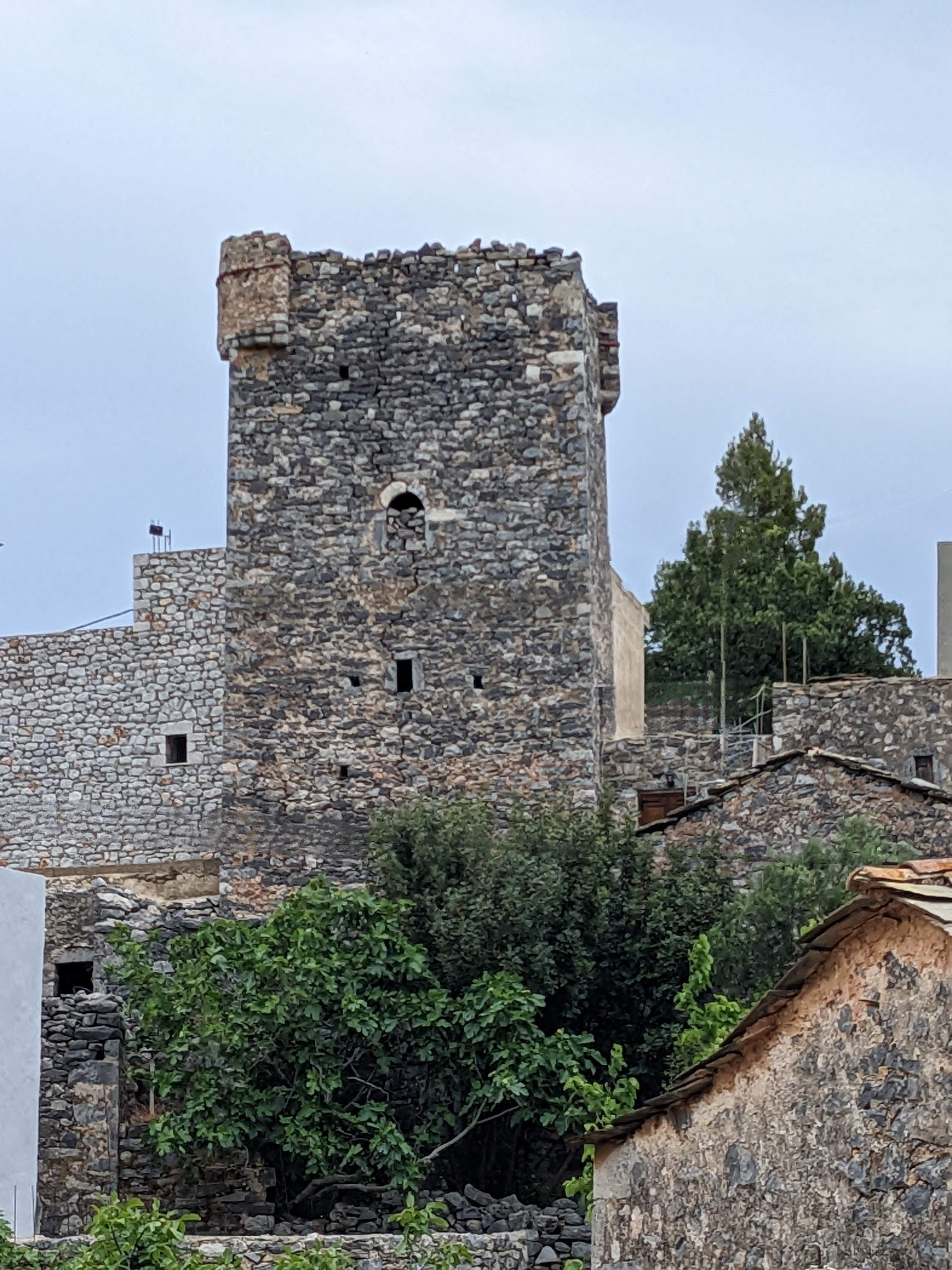
Mani is known for its stone towers with gun-slit windows. This one in the village of Dimaristika belongs to members of Susan’s family.
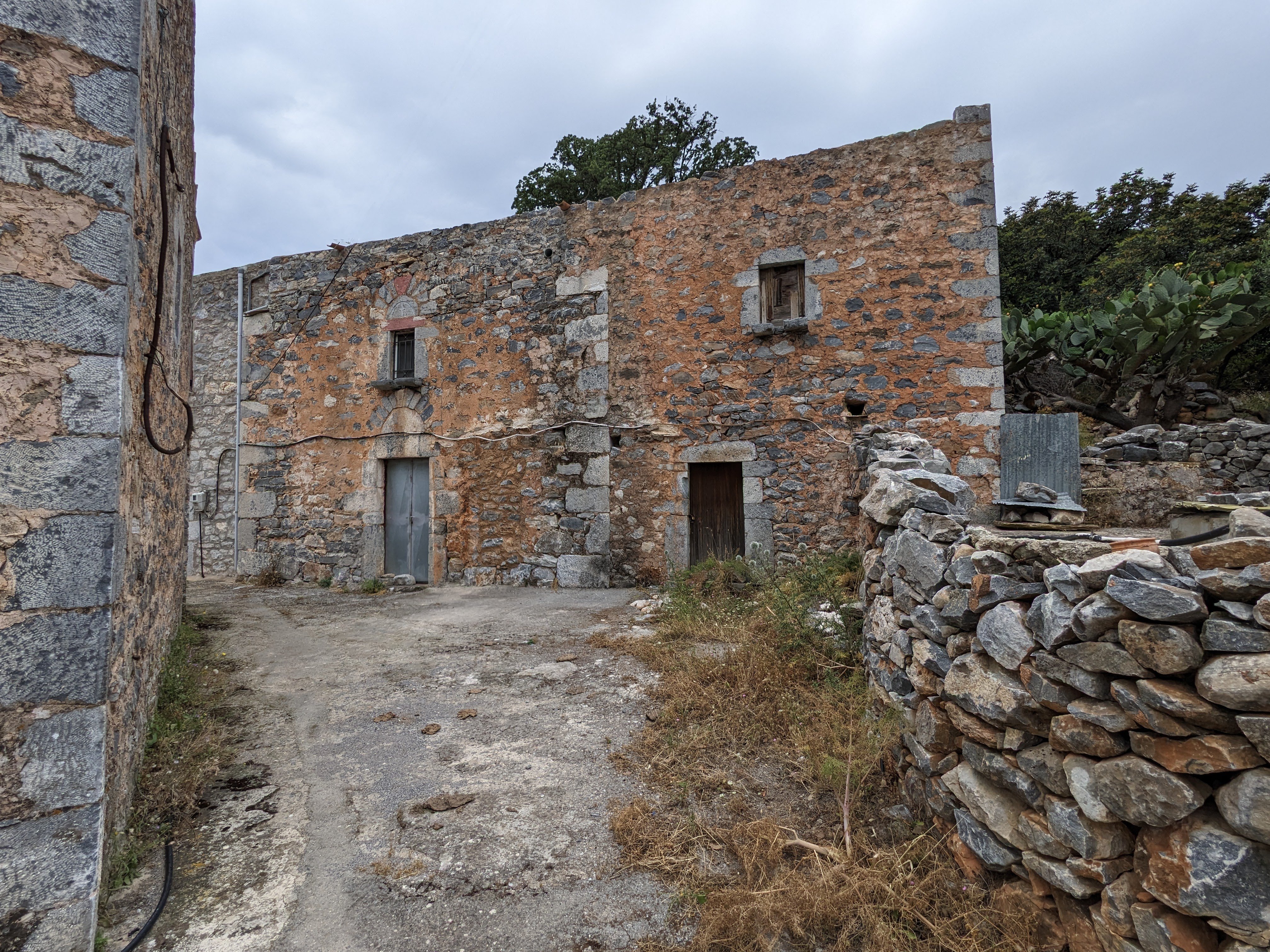
Abandoned houses in Dimaristika.
One of our favorite villages in Mani, Agios Kyprianos.
The full moon rising over Mani on the night of our wedding anniversary.
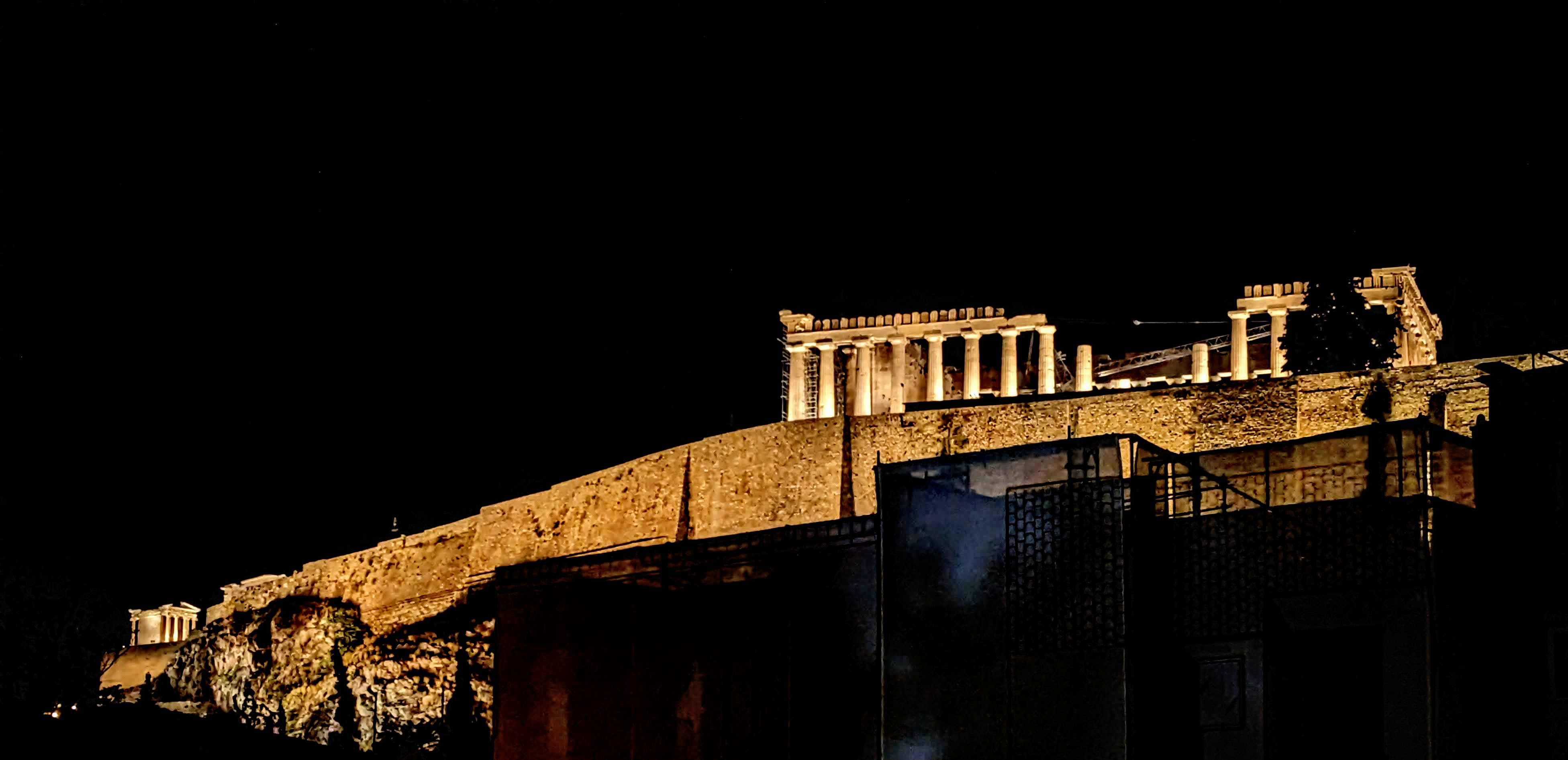
Finally, the Acropolis from the terrace of the Acropolis Museum. I’d never been on that terrace at night before. That perfect little temple of Athena Nike on the far left is one of my favorite places on the Acropolis.
As we count down the last few days of our time in Greece this year, we’re in the middle of the second week of a heatwave. The heatwaves are named like storm systems, and this one is Cleon, an Athenian general in the Peloponnesian War. In Italy the same system is named Cerberus, the three-headed dog that, in Greek mythology, guards the gates of Hades to keep the dead from escaping. (Apparently, meteorologists in Italy have a sick sense of humor.) The scorching heat and the hordes of tourists from Athens overrunning this tiny village make it easier for us to leave. The natural beauty, and the family and friends we will miss make it more difficult. I’m sure there’s a Greek philosopher with wise words about situations like this but I can’t remember them. We have plane tickets, and we’ll use them. And then, when August turns to September, we’ll start thinking about the sweet late summer days of warm afternoons and cool evenings, the mild sea waters, the pastel shading of the mountains across the Gulf, we’ll open a nice bottle of wine from just south of here, and we’ll talk about our next trip.
I’m happy to report that there have been no observable changes in Sykia during the eight months we were away. All of the tavernas and cafes survived the winter, which is reassuring. The seaside tamarisk trees got a good, and much needed, haircut at some point, and the In Memoriam notices on the power poles have accumulated in this village of mostly retirees but otherwise it’s exactly as we left it in November.
It’s a different story in the neighboring village, Xylokastro, the “big city” to our tiny hamlet. There, the transition from retail to service continues unabated. The gift shops are almost all gone, as are the boutiques, replaced mostly by cafes. Even in Greece, however, there’s a limit to the number of cafes that can be supported, and stretches of the main shopping streets are marred by strings of empty storefronts. The couple of tavernas that closed were quickly replaced by newcomers and all the others are soldiering on but it’s difficult to see how the gutted shopping areas are going to recover.
Undoubtedly, loss of income is the cause of the transition. Wages have been cut generally, taxes have been increased, new taxes created, and most importantly in these small towns of mostly old folks, pensions have been slashed each year, with yet another cut pending in the next several days. Kids are graduating and moving to Athens or abroad for work, further raising the average age of the population out here in the sticks. Sykia is too small to have had any actual retail, so it’s been spared the blight, and towns in agricultural areas appear largely unchanged because the income level has been relatively constant but the places that relied on Greek tourists coming into town with a little extra spending money have really suffered. Absent a dramatic change of some sort, it looks like a long road back for Xylokastro.
On the bright side, the NY Times published an excellent article about Athens the other day (Athens, Rising), in which the locals opine that maybe, just maybe, there’s a possibility that things are beginning to pick up. It’s the first time I’ve seen any public optimism in the last 9 years.
It’s been summer weather since we arrived, and on Friday school dismissed across the country. We’re now on the ramp-up to the full summer bedlam that is the August holiday. Kicking off the festivities is the European Day of Music on Thursday. Sykia is participating for the first time this year by hosting approximately 20 musical acts, ranging from classical to pop (European Day of Music). Naturally, the “Day of Music” requires 4 days to celebrate. We’re looking forward seeing how this goes. The schedule makes it sound as if some of the acts will perform on the beach but that’s hard for me to picture. The first day concludes with a concert of traditional music in the plateia directly in front of us — from 10:30 to midnight. Yes, a concert in the middle of a residential area beginning at 10:30pm. Kansas, it’s not.
After the madness of moving it’s especially sweet to be back here, watching the wind sweep the water. We’ve got a few tasks to accomplish but otherwise the plan is to appreciate each moment of these long, sweet days as slowly as possible.


























 greekdreaming