

A dusty store window in Xylokastro, the town next-door.

This hideous snarl of wires inhabits a deep, dark, damp pit under our parking lot. It is the junction for the telephone wires leaving our building and the cable that connects the complex with trunk line in the street. If you look closely, you’ll see the little splices in the twisted pairs. If you look even closer, you’ll see 2 or 3 inches of water in the bottom. As far as I know, the water is permanent. Last year I joked with the telephone company guys about fishing in it. Har, har. Predictably, every time we have phone/internet trouble the fix involves a fresh splice. In the meanwhile, every syllable and every bit of data from us to the world goes out through that pit.
Arthur C. Clarke wrote, “Any sufficiently advanced technology is indistinguishable from magic.” Here, it’s indistinguishable from the miraculous.
NB: Susan, in a fit of pique raised by OTE, the Greek National Telephone company, commissioned this post.
PS: All too appropriately, the day after I posted this, the telephone portion of the service went out. Mercifully, the internet side remained operational. At our local phone emporium, a very nice young woman speaking great English called the repair service for us and, 12 hours of patience later, a phone call came in from OTE to inform us that the problem, QED, had been fixed. Hallelujah!
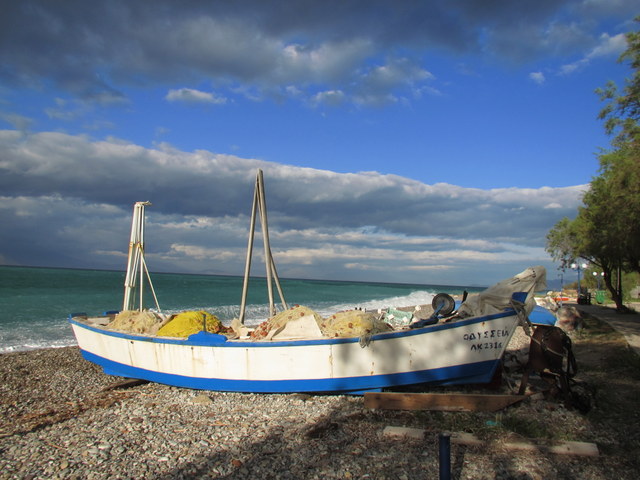
Odysseia, the name of this fishing boat on the Sykia beach, is Odyssey in Greek. Many Greek fishing boats are named for saints, particularly Agios Nicholaos, the patron saint of mariners, but not all. Many are named for wives and daughters, places, or they bear words I don’t recognize. The Odyssey is Homer’s tale of Odysseus’ 10-year journey from Troy back to his home in Ithaki — the island we call Ithaca. His trials during that voyage make Odysseus perhaps history’s most famous and most reluctant sailor. I don’t know if the master of the craft on our beach is alluding to Odysseus’ fame or reluctance but it’s nice to see a reference one of ancient Greece’s finest contributions to world literature.
Recently, archeologists have cast doubt on the island of Ithaki as Odysseus’ home. It is said that Homer’s description much more closely resembles the near-by island of Kefalonia. But ruins of the appropriate era have yet to be found on either island so, for now, the Odyssey tours and the Homer tours still conclude at Ithaki.

It was a windy day in Sikya, with the west wind blowing straight down the Gulf at 8 Beaufort. What’s a Beaufort, you say? The Beaufort scale was devised during the age of sail, with subjective measures for each of the twelve steps on the scale. One is dead calm, twelve has the wind whipping the tops off the waves. I’d read the term in a book but had no real understanding of the scale until I returned to the States after particularly windy ferry ride to Santorini, and looked it up in the Bowditch Practical Navigator. As an intensely nautical nation, Greece uses the Beaufort scale to measure wind speed — although the scale is a more objective today. The 9 measured just west of us was given as 77 kph, and two places in the country measured force 12 winds, given as 135 kph. The ferry captain told us that at 10 Beaufort he is permitted to use his discretion as to whether he sails — above that, he must stay in port. Our experience with the Spring and Fall winds have made it clear why the ancients, in their rowed galleys, adhered so strictly to the rather short sailing season in this part of the Med.
This pretty picture was shot just before sunset when the wind had dropped off, leaving only the high surf and the wild clouds as evidence of what had gone before.

I don’t know the Greek for this phenomenon but occasionally in the Spring, atmospheric dust carried aloft across the Mediterranean from North Africa, is brought to earth by rainfall. That happened this morning at dawn, and we awoke to muddy mess on our balconies. Obviously dirt that remains in the atmosphere for thousands of miles and across a body of water as big as the Med is powder-fine, and it makes a sort of mud that settles in the smallest niches.

View off the back balcony down at the parking lot.

The car didn’t look as bad as the balconies but it’s very much in need of a bath.

This house, near the shore and at the very edge of Sikya, preserves the traditional style of beach house design in this part of Greece.

Saint Blaise, the cathedral church of Xylokastro, the neighboring town. Many of the men from this town are named Vlasios. (Not to be confused with Vasilis, another popular name…)
 greekdreaming