Unknown's avatar

Heat Wave

Heat Wave

We’re just finishing our 4th heat wave of the season. My recollection is that 2 is the usual number. The Greek meteorological service says July was the hottest in 110 years, and June was one of the hottest. I’m not sure how the meteorological service classifies a heat wave but it seems temps of 40 (104 F) or more on consecutive days does the trick. Our normal highs in July and August are 37-38 (99-101) so heat waves are not a huge departure but they seem to be just enough to make the heat unreasonable.

The combination of a sun that feels like a giant directed-energy weapon and the high air temperatures transfers a lot of  heat to virtually everything in the environment, turning the buildings, the roads, the trees, the dirt, even the seas into passive solar radiators. Walking around at night one experiences the unusual (for me) sensation of heat radiating from below.  And I can tell when I’m approaching the front wall of our building with my eyes closed.  This radiation from the environment keeps the nighttime temps relatively high, even in the absence of high humidity. The normal low is about 25 (75), and we haven’t seen a morning low below 22 (69-70) in 2 months.

The heat is one reason why we advise against visiting in July and August. This photo was shot about 3pm on August 27. The probe is 3 inches below the surface of the beach. I did the same measurement at the end of July and the temp was 105.  I recorded a water temp of 80-82 that day and, having left the probe on my beach towel while I swam, I observed a reading of 130 when I returned.  I shudder to think about the interior of the car in mid-afternoon.

Now, with the solstice 2 months past and August rolling to a close, we are looking forward to the return of the west wind, the occasional cloud overhead, and maybe a little cool, cool rain.

Unknown's avatar

Dimitris Arapis

We lost Sue’s great uncle last Thursday.  He was 99 years old.  Our family owes him a great personal debt of gratitude because it was he who repeatedly insisted that his son, who was stationed in NYC at the time, find his deceased uncle’s family in the US, and make contact.  With no help at all from us, Nikos was successful, and that led directly to our living in Greece half the year.  More importantly, it reunited Susan and Andrew with a part of their family previously thought to be as lost to us as the European relations of most American families tracing their roots to a forebear from the Old World.

It’s not possible to summarize a life in a blog post but ever since I first met Theo (uncle) Dimitri, I’ve marveled at the changes he saw during his life.  He was born in the deep Mani during WWI, in which Greece’s great historic enemy lost their empire.  As a child, his parents (his father was an Orthodox priest) relocated the family to Piraeus, the port of Athens.  As a pre-teen, he witnessed the sudden doubling or trebling of the population of Athens when 1.3 million christians  were forced out of Turkey by a “population exchange” treaty imposed by the League of Nations to stop the genocides in formerly Ottoman territory. (The treaty also required about 355,000 muslims to return to what had become Turkey.)  Theo Dimitri entered the Athens police force, and served as a policeman during the years of the Nazi occupation, when at least 40,000 Athenians died of starvation.  He and his wife raised five children, all of whom have survived him.  His wife died decades ago.

He was a fine head of the family, love guiding him in all things.  He was also a fine singer and he sang when he was happy, as at virtually every family gathering we attended.  During his homily, the priest at the funeral service said that whenever he heard that Theo Dimitri was back in the Mani, he would call to ask him to chant during Mass.  I made a video of Theo Dimitri singing what I call The Mani Song — simply a love-song to his homeland.  He was very proud of his Mani roots, and, beginning in the 50s, every summer he took his young family on a ferry (there was no road) to a then-abandoned seaside village in the deep Mani, not far from where he was born, from where he first went to school, and from where he rests today.  The ferry voyage took about 24 hours back then, having made stops at seemingly every bay and cove between Piraeus and Messinia. The family and all their supplies for the stay had to rowed ashore in the ship’s boats. Theo Dimitri  began by renting a house from an absentee landlord but eventually he bought the place for the family.  In doing so, it became the first re-inhabited house in the village.  Today all of the houses in the village are re-inhabited, at least in the summer.

Theo Dimitri loved to tell stories and he told us about walking across Mani at night with his father, about the unforgettable aroma of the fruit from one small area on the slopes above Porto Kayio, and about how he kept perishable food in Mani’s August heat without refrigeration or ice. Perhaps my favorite is the last I heard while he lived, relayed through his son.  When a person dies in Athens, the next of kin turn his identity card in to the police to obtain a death certificate.  The first line on the back of the Greek identity card, until it joined the EU, was religion.  The German looting of the countryside for food to feed their troops led to mass starvation in Athens, and identity cards were being turned in faster than they could be registered. So Theo Dimitri and some of his colleagues would pocket the occasional identity card and give it to a Jew trying to hide from the Nazis.  The recipient would have to open the lamination and move the photo from the old card to the new one but then he would have a very proper-looking identity card for a person of the Orthodox faith.  When Nikos told us this story he said it was the first time he’d heard it.

Go with God, Theo Dimitri.  We miss you already.

Unknown's avatar

Sikya Sunset

Sikya Sunset

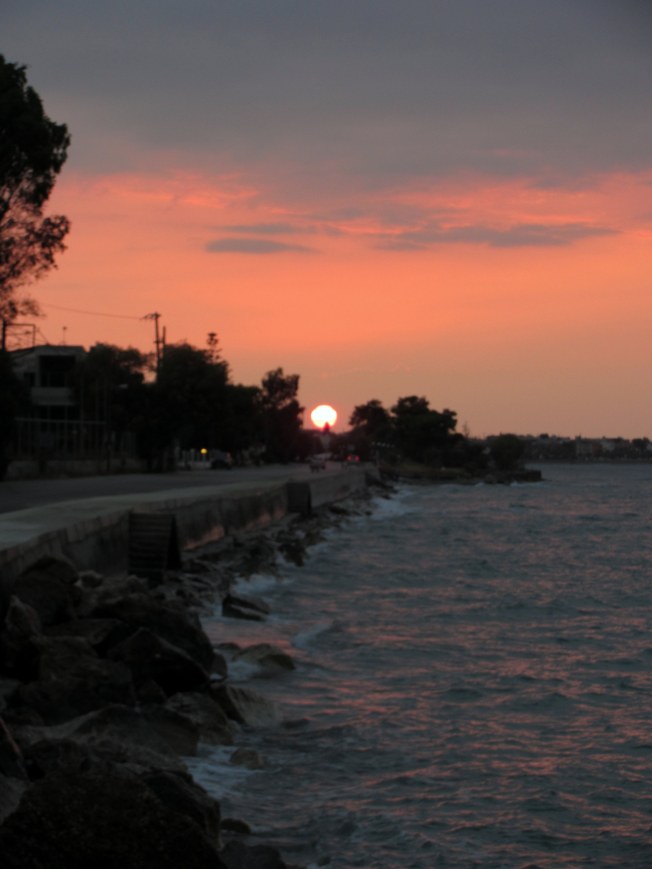
Sorry about the soft focus — the camera was having a moment — but I thought the colors were nice. We had some clouds this afternoon so the sunset was colorful and I just happened to be coming back home from Melissi when the sun was resting on the horizon.

Unknown's avatar

The scent of ruins

The scent of ruins

Decaying areas in cities usually produce an odor that I think smells like wet newspaper. Whether it’s here or in the US, the deterioration of old buildings gives off the distinctive funk of rotting cardboard, books, paper.

The ancient sites of Greece also have a particular odor but in this case the scent is of herbs: heated herbs. Hints of oregano, thyme, and sage waft above the browned weeds that surround the ancient walls and stones. Which is pretty reasonable considering that wild versions of those herbs and others are ubiquitous in Greece, and that the summer sun here bakes every low green bush to dust by the time fall’s rain arrives. The olfactory effect is not so much Thanksgiving dinner as the almost subliminal awareness of a familiar, pleasant scent rising from the weeds as you walk; a perfume that over time becomes associated with tromping around ancient stones.

Sites lucky enough to enjoy the presence of pines have that delightful note in addition to their summer bouquet, and it adds a peaceful, calming tone that is perhaps attributable to but certainly reinforced by the blessed shelter from the sun provided by those trees.

The site of ancient Argos does not enjoy the presence of pines but the scent of herbs in those browned-out fields is almost palpable as I look at this photo.

Unknown's avatar

Suddenly, Summer

Suddenly, Summer

Summer showed up yesterday. To be sure, we had a hot day in Athens about a month ago and a hot day on Hydra last week but yesterday this place finally felt like a beach and today,  with a high in the mid-90s,  we took our first swims in the Gulf. The water’s still pretty cool but there are warm spots floating through so it’s not too hard to bob like a…half-empty beer bottle or a semi-inflated wine-skin while taking in the streaks and spots of snow remaining on Parnassos. Everyone who made the trek from Athens this weekend is on the beach, and so are we. But not in this photo.

Unknown's avatar

The Wine-Dark Sea

The Wine-Dark Sea

In the Odyssey, Homer almost never refers simply to “the sea.” Invariably he uses the phrase, “the wine-dark sea.” My guess is that with the tortuous meter in which he worked it was useful to have phrases he could just plug into a line, knowing they’d scan. Also, the repetition probably helped him developed a loping pace that would carry the story along. He does the same thing when referring to the gods and leaders of the Trojan War. Got it. What I don’t get is the image. I’ve never thought of the sea as “wine-dark.” “Deep and dark,” “dark as night,” “deep blue sea” all paint a picture for me but “wine-dark sea” just makes me think of purple water. Or, in less lucid moments, blue wine.

I spend long moments here looking at the color of the sea. Today, under a bright, hazy sky and strong winds, the sea was predominantly cobalt with lacy whitecaps setting off the blue. Sand washing from the point upwind created a turquoise streak about a hundred meters offshore. I’ve seen the water gunmetal blue, cold grey, and something Susan called “azure.” I’ve seen it ultramarine, sea green, cerulean, Caroline blue, midnight blue, navy blue, sapphire, and teal but I’ve never seen it any color that reminds me of wine.

I don’t think Homer was simply referring to an absence of light, eg: the bottom of the sea is as dark as the bottom of a wine amphora. I think there was some cultural/linguistic/semantic significance to the image that resonated with ancient Hellenes. Maybe the association of wine with a rolling gait, the sensation of the ground moving, an unsteady horizon had something to do with it. Maybe drinking wine was thought to be like taking a sea voyage. Maybe dipping into the amphora was as uncertain as setting sail. Maybe it was even dangerous.

For modern Greeks the highest compliment bestowed on the water is “the sea is like oil.” For us, that simile has a distinctly unpleasant connotation but, for swimming, the Greeks like still water, and a perfectly flat, mirrored surface is the best of all — a sea as calm as a bowl of olive oil. I think something like that made Homer’s image work for the ancients. I just don’t know which bit of communal experience he was tapping into. Perhaps one day, sitting out on the balcony, maybe even sipping a glass of wine, there’ll be a eureka moment and the penny will drop, the skies will open, the angels will sing. Maybe not. But I’m enjoying rolling this particular nut around in my mouth, searching for something my tooth can pry into. Consulting a text on ancient Greek would probably be easier but what fun trying to meld one’s imagination to an ancient consciousness.

Unknown's avatar

Election Day, Redux

Election Day, Redux

As feared, the May 6 parliamentary election failed to produce a clear winner or even enough like-minded parties to cobble together a coalition government. Sixty percent of the populace voted — voting is technically mandatory — with the others protested by not voting. Seven of the 32 parties on the ballot gained enough votes (3%) to win a seat in the parliament. In the anger and desperation of the moment, the two parties on the fringes experienced new levels of success. The KKE got 8.5% (26 seats), up from probably 6% in 2009 and a bunch of neo-nazis who never before had a seat gained 7% of the vote for 21 seats. The big story was that the leftist party Syriza came in second, displacing the center-left party Pasok that has led Greece for most of the last 40 years and that had won a disproportionate majority of the seats in the 2009 election.

The leaders of each of the top three parties tried in turn to form a coalition government and then the president of the Republic tried mightily for 3 days to convince party leaders to agree to a coalition for the good of the country. After the 9 days provided by the constitution for attempts at coalition-building, the president then called a new election for 17 June, and appointed the chief judge of the highest court as interim Prime Minister, also as specified by the constitution. The elected parliament was sworn in on Wednesday and dissolved the next day, the shortest parliament in Greek history, and Thursday afternoon, Greece swore in its 184th Prime Minister since 1822, the 3rd in the last 6 months.

The news media focused its attention on the most sensational aspect of the election, and Andrew said that on his way to work the next morning he heard it reported that nazis were in power in Greece. Chrisi Avgi (Golden Dawn) is a gang of rabid anti-immigrant thugs that has gained popularity in the poor neighborhoods of central Athens as a result of the government’s total failure to address illegal immigration. The land border with Turkey has been left generally unguarded and every night several hundred immigrants, mostly Pakistani, simply walk across the border and into Europe. While the Greek government makes only showpiece attempts to detain and return the immigrants, the western European countries are much more serious about it. Strangely, however, EU law provides that immigrants detained in western Europe are not returned to their native countries but to the European nation they first entered. So Athens has been packed with immigrants from both east and west. They are living 40-50 to an apartment, they peddle bootlegs, knock-offs, and crap novelties in the tourist areas, infuriating already hard-pressed legitimate shopkeepers and, since there are no jobs, there’s a lot of crime in the poor neighborhoods. Athenians are freaked out about the situation and, in this volatile environment a group of vigilantes has gained considerable popularity by filling in for absent law enforcement. For those of us who can’t imagine how the Nazis could have risen to power in Germany, this is a very instructive case study.

In the shock of Chrisi Avgi’s election to parliament, it was discovered that there is an EU law that prohibits a neo-nazi party from holding seats in any EU-member parliament. Chrisi Avgi quickly backed off its claim to be a neo-nazi party in response. They have, however, repeatedly used photos of Third Reich leadership in their party literature, they greet each other with the nazi salute, and they use a swastika knock-off for their party symbol so no one is deceived and one of these days we’ll see a clear and unequivocal ruling from the EU. I hope.

The more important story of the election is the rise to power of Syriza — an acronym for Coalition of the Radical Left in Greek. And they are left. Not center-left, not socialist, but left-left. They have a young, charismatic, clever leader who has capitalized on the population’s misery after a succession of wage and pension reductions by telling people what they want to hear — that they can reject the austerity provisions of the financial rescue agreement but still receive the rescue funds.  Despite my cynicism, Alexis Tsipras has been remarkably candid in his campaigning. He has a 5 point program that includes rejecting the terms of the rescue package and nationalizing the banks. In my view, his flaw is that he has promoted the fiction that the euro zone cannot afford to let Greece default and ditch the euro. I think the euro zone has spent the last 2 years preparing for the eventuality of a Greek default and exit from the euro zone, and has firewalled itself well enough to have a bottom line approach to the problem.

We may well have a chance to find out who is right but the public discussion has now evolved to the point that most believe that a vote for Syriza is a vote against the euro zone. This will make for a pretty pure referendum on the issue, although the pro-euro parties are now saying they will insist on a softening of the austerity measures and launch a campaign to stimulate growth. I doubt there is nearly as much negotiating room or stimulus money as the public would like to believe (or will be led to believe) but this new election will be essentially a choice between austerity in the euro zone and default with a return to the drachma.

Despite the need to open envelopes and tally the results from paper ballots, election results were delivered very quickly on the evening of the election, with an official website providing the results of the tabulation parsed in a variety of ways. If the same contractor is used, the evening of 17 June should be riveting. Also, I note with pleasure that so far, there are no campaign ads on TV. The government provides the campaign funds and I guess the new administration will have to decide whether to disperse additional funds. I’m hoping they opt for austerity.
Unknown's avatar

The Mayor

The Mayor

I assume every village/town has its characters; Sikya certainly has a couple. The man I’m thinking about just now we christened “The Mayor” in our earliest days here. In fact, I don’t know if Sikya has a mayor — it may be too small — but if it does this guy is no more the real mayor than the real Archbishop of Canterbury.

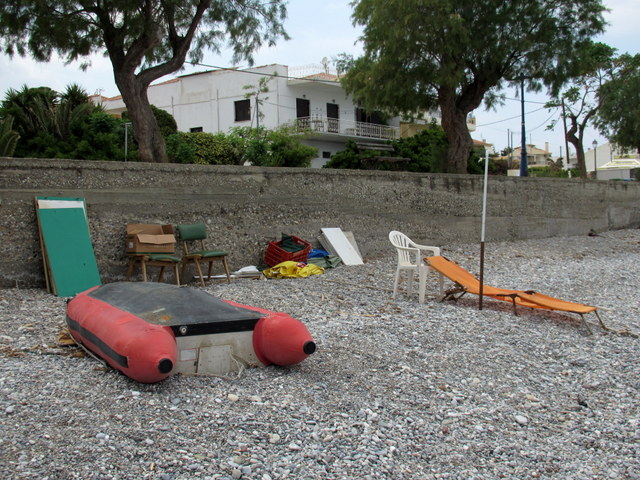
The Mayor came to our attention because of his remarkable persistence and consistency. Every summer day without fail he sits in his camp on the beach, from dawn to dusk, staring out at his boat moored just offshore. Most of the time he sits alone; occasionally one or two of his cronies will sit with him. I’ve never seen him in the water. As far as I can tell, he can’t swim. On the odd day when the mood strikes him, he rows himself out to the boat in his half-inflated inflatable, which I refer to as “The Dingy Dinghy.” On these days, he most often sits on the boat, which is tied to its mooring buoy. Sometimes, he plays the radio. Sometimes, he fishes. After a few hours, he rows himself back to shore and resumes his watch on the beach. On great occasions, he fires up the motor, lets slip the mooring line, and cruises out a few hundred yards before cutting power and drifting in what is usually glassine water. On a few most remarkable days, he has roared out of the cove and out of sight, invariably causing me to wonder what wild fantasies must be running through his mind.

As you may have noticed in the photo, the mayor’s camp has a certain aesthetic. This same aesthetic runs through everything I know about the man– and I’ve seen his car and I’ve seen his scooter. The Dingy Dinghy is emblazoned with the legend (in English), “Tender to ‘Old Blue.’” One year we were amazed when his boat re-emerged from its winter shelter, its outboard motor having been freshly painted, with a brush. The next year, we were again struck when the boat itself (which I call “The Scow”) appeared with a fresh paint job, also brush-applied. Most recently, the torn canvas canopy was replaced with a snappy blue tarp.

This year, a new inflatable has appeared. This one is moored offshore, perhaps in the spot where The Scow has been secured. If it belongs to the mayor, it is unusual in that, 1) it holds air, and 2) it has a motor. My summer will not be complete until I see if this new addition to the Sikya flotilla belongs to the mayor and, if it does, how he incorporates it into his fleet. Does the new inflatable replace the Scow? Will he row out to the new inflatable and then motor over to the Scow? Will he visit one for awhile and then the other? Will he visit one on odd days and the other on even?

As far as I can tell, the mayor owns nothing that hasn’t been salvaged — including the car and scooter. If the new inflatable is his, it must have been a red-letter day when it came floating down the Gulf. This business of making do and living cheap is all very Greek and endearing, even if it is a little extreme in this case. My hesitance arises in the matter of personal hygiene. When we were overseeing the last month of the construction of our apartment, Andrew and I spent the siesta part of the day out on the beach. The mayor was there every day too, of course. What became alarming eventually was that he looked the same everyday — exactly the same. Not just the Goldwater glasses, the salt-and-pepper hair, the shipwreck tan but also, I’m sorry to say, the shorts. The mayor’s uniform in August consists of shorts and sandals. The same outfit I and most of the local men affect. The big difference is that while I and the other male residents of the village change our shorts, the mayor seemed to have found it more efficient to just wear the same pair all day, every day. We stayed well clear of the camp that summer.

I am happy to report that a box of shorts must have washed ashore since that first year as ever since then the mayor has appeared at irregular intervals in different shorts. I can’t say they look freshly laundered but they are at least different. As with the Scow’s renovation, this too seems to be a work in progress.

Unknown's avatar

The Dogs of Greece

Mountain Dogs

This is quoted in its entirety from The Mountains of Greece by Tim Salmon:

This is a serious warning. The sheepdogs — guard dogs, not collies — are the greatest danger you are likely to encounter in the mountains. It is not the little mongrels that guard some flocks that you have to worry about, but the Molossi. They are wolf-sized, half-starved, unused to strangers and very fierce and, like the arrows of outrageous fortune, never come one at a time but in gangs. They will never let you pass without attacking. If at all possible, give them a very wide berth. Always carry poles or a stout stick and be aggressive. Keep them at pole’s length and throw rocks at them with the intention of hurting them. If you don’t, they will hurt you.”

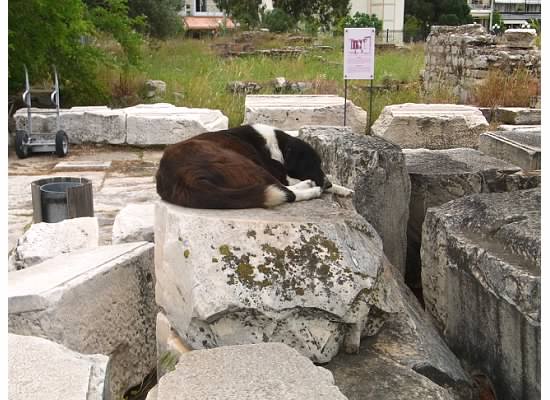
While this startling warning has been enough to cure me of any thoughts of solo mountain running in Greece, I have to say that the dogs around here and everywhere we’ve gone across the country have been uniformly sweet to benign. Some bark like crazy, some run away, but most just keep on sleeping. I can’t think of an archeological site we’ve visited that isn’t overseen by at least one dog, such as this guy guarding an ancient marble fragment at the site of ancient Eleusis.  I’ve never seen them cause trouble unless sorely provoked by some ignoramus.

While many Greeks these days have dogs as house pets, the rule of thumb in Athens seems to be that individual apartment buildings have a dog or two communally.  The dogs live in the garden outside and one or two people provide food, water and vet care.  I think the same sort of thing applies at the archeological sites — one or two of the workers provides for the care and feeding of the resident dog.  This gives the first impression of a lot of stray dogs roaming the city but, while no one “owns” them per se, they’re not really strays.

It appears many Greek dogs have English names. Max is popular and I’ve run into a Killer, an Ivan, and an Igor.  We stayed with a family on Santorini who had a pooch named Doggie — kind of like if I named a dog Skylo (dog) or Skylaki (doggie).

Greeks love dogs and dogs love Greece, so I guess it just takes a half-wolf to guard sheep.

Unknown's avatar

The Bells of St. Sykia

http://youtu.be/t2AqtvpMPLA

I’ve heard church bells pealing over the rooftops of Paris, been enchanted by the sonorous tolling from the church towers in Venice echoing down the canals, experienced a magical moment on a hilltop on Folegandros when the Sunday morning bell ringing spread like sunshine from church to church across the valley below. And, of course, I’ve heard the loudspeaker “bells” of the churches in Gambrills. But I’ve never heard anything like the bells in the church behind our apt. I’m embarrassed to say I don’t know the name of the church so I’ll call it St. Sykia for now.

I guess the original idea behind church bells was to let people know when it’s time for church. The priest here has plainly updated the idea to the modern era: church bells as alarm clock.

Our first night in our new apt., after a very busy day, we were sound asleep (on a mattress on the floor) when these bells went off at about 7:35am. It didn’t occur to either of us that they were intended to call people to church. The time wasn’t on the hour, the half-hour, or the quarter hour, and it sounded like no church bell we’d ever heard. We thought they were signalling an emergency — a wildfire, a tsunami, a sighting of the Turkish fleet — but it never dawned on us that the purpose of ringing bells like this could be simply to wake everyone up. We were up, out of bed, peering out of the windows and craning our necks over the balcony in a flash. Amazingly, none of our neighbors seemed to have noticed or responded to the call to action. In fact, no one was moving about at all.

Of course one can’t go back to sleep when convinced that some sort of civil emergency is imminent so we started the day, keeping one eye out the window. The penny dropped about 15 minutes later when the belfry went off again. It clanged its final warning about 5 minutes before services (it’s a small village). We were drop-jaw stunned to think that any church on the planet would be rude enough to produce a noise so irritating and so loud so early on Sunday. Boy, did we have a lot to learn.

This clanging began at 8:35am on Saturday morning. It went on for 90 seconds — the video’s a bit dull so I’m sparing you the full effect. I think there are two bells in the tower. The bells are stationary; the clappers are driven by some sort of electro-mechanical device. Whoever dreamed up this particular sequence has done more with two bells than I would have imagined possible, even if it does come across with kind of a  clang-bong, clang-bong, “broken leg” rhythm.

Under Turkish occupation, Greeks were not allowed to ring church bells — only the muezzin in minarets could call people to prayer. Other places in Greece seem to have got over it. Here in Sykia, the priest is apparently trying to make up for the 400 lost years.

Edit:  The name of the church I refer to here as St. Sykia is actually Agios Koimiseos Theotokou.  And that’s probably why it slipped my mind.