Unknown's avatar

Ode to a Grecian Salad

Ode to a Grecian Salad

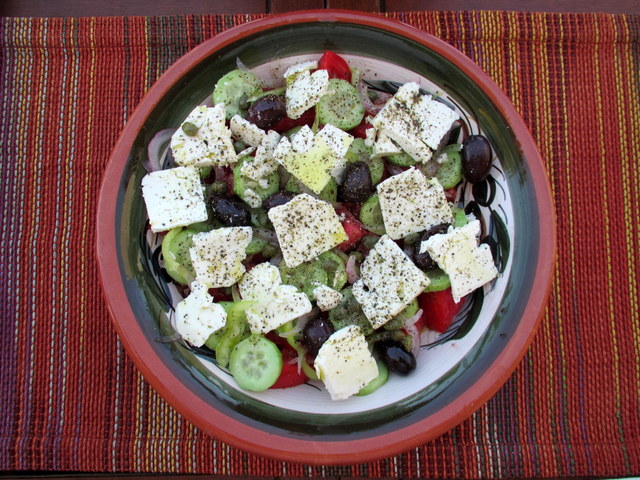
OK, it’s not an ode but it is a Grecian salad. Horiatiki, thy name alone inspires reverence and appetite. Horiatiki salata is the quintessential Greek salad, the salad that is ambrosia in the home country and an embarrassing, pale imitation in the US. “Horiatiki” means “village style,” which in turn means simple, fresh, unadorned. To make a good, true Horiatiki salad, the vegetables must be in season and very fresh, the feta must be Greek and served in a single large chunk, and the oil must be very good olive oil. An unwillingness to compromise on the vegetables means that Horiatiki is only available here in the summer which, mercifully, is quite long. The dreadful “Greek Salad” or “Village Salad” that one finds in most Greek restaurants in the US usually fails on all three counts: the tomatoes are either yellowy or hothouse, the feta is crumbled (a sign of uncertain quality), and the oil is cheap, if it’s not canola. And, if you see leafy green stuff (eg, lettuce) in your Horiatiki, well…your salad is beneath contempt.

Now, while I agree that a person whose skill in the kitchen is limited to taking something out of the freezer and putting it in the microwave should not be allowed to promulgate a recipe, my affection for Horiatiki (I’d have it twice a day if a certain someone would let me…) emboldens me to venture into that strange territory. Thanks to the cooperation and patient instruction of my better half, I offer the following pictorial on the proper, God-given, canonical method of preparing this simple, perfect dish.
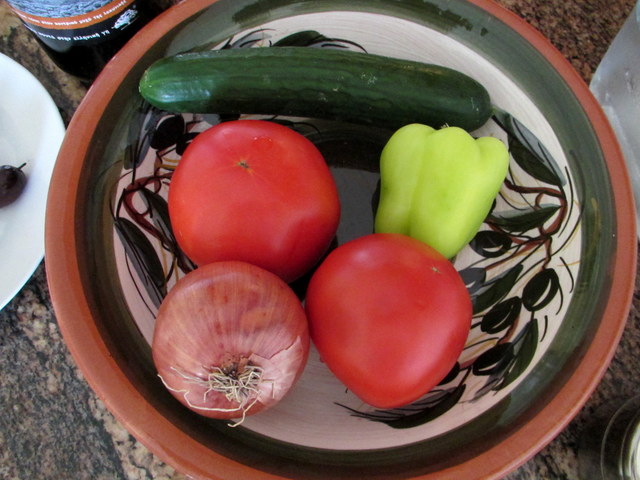
First, go out to your garden and pick a fat, perfectly ripe tomato for each person. If your garden has failed or fails to exist, a good truck farmer can usually supply real fruit but beware the supermarket: plastic, flavorless tomatoes cannot be substituted. The green pepper should also be garden fresh and very mild, and the cucumber should be crisp and peeled. Mildness is also a virtue when it comes to the onion, which can easily overpower everything else. Some people (you know who you are) consider capers optional; I do not. I’ll get to the olives in a bit.

Cut the tomatoes into bite-sized chunks and put them in the salad bowl.

Season the tomatoes with sea salt and set aside. Peel and slice as much cucumber as you feel appropriate. Slice a small portion of the onion as thin as possible and cut the rings into quarters (90 degrees of arc for you scientific types). Slice the pepper as thin as the onion, and don’t leave your guests to deal with pepper rings: cut them up. Use enough pepper to serve as a heavy garnish (a quarter of the pepper).
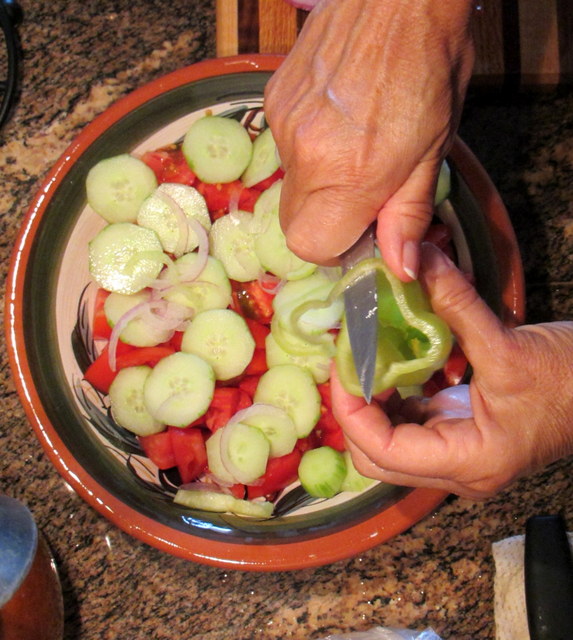
When the tomatoes have had at least 5 minutes with the salt resting on them, layer on the cucumber, onion and pepper.

Olives are an area for personal expression. We like big, black olives from Kalamata (90 minutes south) but Greeks use a seemingly endless variety of local olives, so you can’t go wrong here. (Note for the record: olives have pits. Pitted olives are unacceptable. Also, olives stuffed with pimentos are best reserved for martinis.)

We like 4 or so olives per person but you’ll never get that many in a taverna, so add them as you’d like.

Sprinkle on a couple of teaspoons of capers.

If you don’t like capers for some odd reason, don’t eat them. But they give an extra dimension of flavor to the salad, and so should always be added.
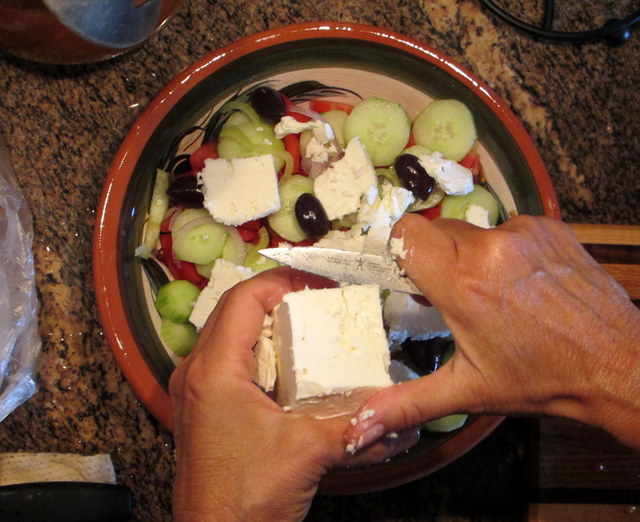
Since you know your feta is of high quality, feel free to slice it into easily spooned slices, as we do, or do it the way all tavernas do and just lay a huge block artfully on top.
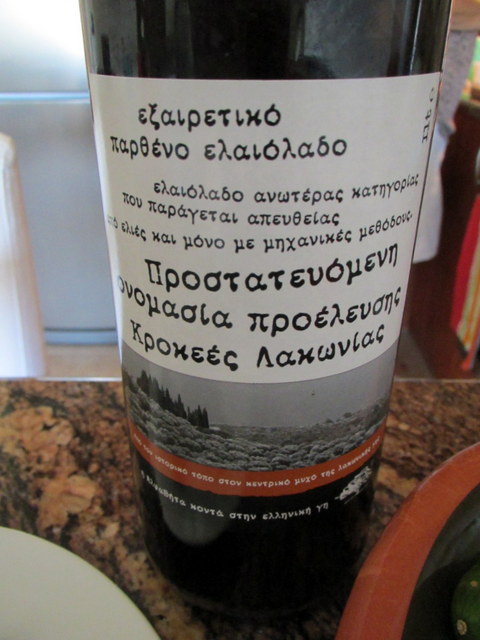
Now’s the time to add the olive oil. Needless to say, extra virgin is required, and your best olive oil should be reserved for your salads. (And ice cream, if you go there.)

Drizzle the olive oil liberally over the salad. For some of us (who shall remain nameless), the whole point of a Horiatiki salata is the creation of the amazing tomato juice/olive oil melanage in the bottom of the bowl, which can be best appreciated when soaked up with piece of really nice, crusty, fresh bread. So skimping on olive oil misses half the goodness.

Finally, sprinkle some dried oregano evenly over the entire bowl. I don’t know what kinds of dried oregano are available in the States but the kind we get here is wild oregano, gathered in the mountains and air dried.

Its taste is head-and-shoulders beyond the stuff in the McCormick’s jars, so if you can find some kind of dried oregano with an expressed provenance, give it a try. Add some freshly ground black pepper to finish the salata.

Your Horiatiki is now completed. I think it’s best when slightly chilled, so if you have a few minutes to hold it in the fridge, I’d do it. Regardless, when it’s time to eat, carry your Horiatiki to the table but do not mix it. If the feta is in a block, break it into pieces at the table and back away. Oriste, your Horiatiki is ready to serve. Serve it by spooning it up from the bottom — this way everyone will get all the layers, covered in olive oil.

On the matter of seconds: in Greek families it is accepted that everyone simply eats seconds out of the bowl, including swiping away at the olive oil with hunks of bread. If you’re dining with family or close friends, and this kind of communal dish is acceptable, it’s recommended for the intimacy it brings to meal. Otherwise, the traditional passing-of-the-bowl works just fine.

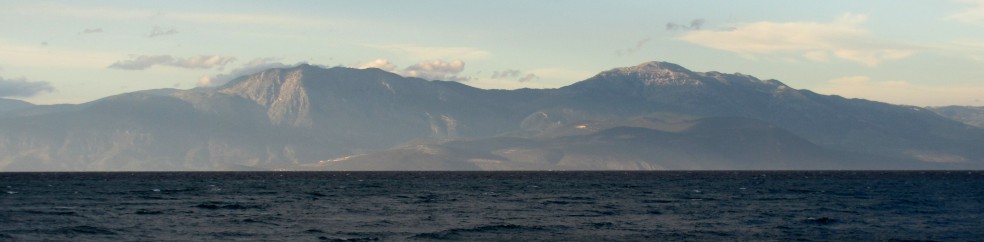
That’s it. Accept no substitutes. Consume outdoors if at all possible. A crisp white wine is a wonderful addition and a hoppy summer beer is sublime. And a tableside view of a Grecian sea is best of all.

Thanks to Andrew, who stands second to no man in his affection for Horiatiki, for suggesting this post.
Unknown's avatar

Apes and Bees

Apes and Bees

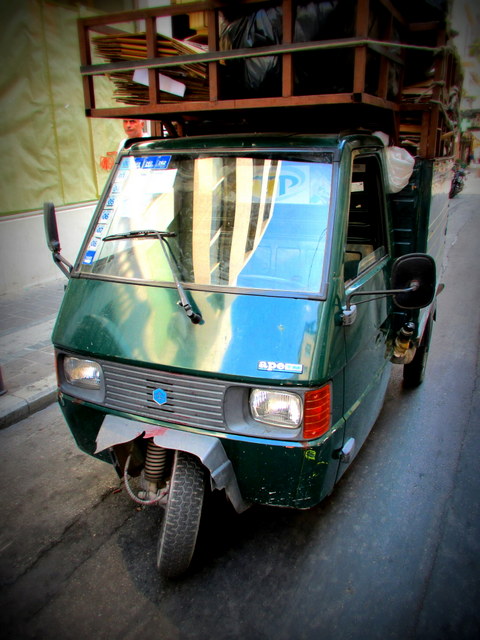
When Sue and I came to Europe on the Grand Tour in ‘72, these little 3-wheeled Piaggio Apes were ubiquitous in Italy and Greece. We had seen them nowhere else in Europe but they were clearly the go-to vehicle for plumbers, builders, craftsmen, and deliveries of all types in Italy. We assumed it was an Italian vehicle for Italians. But when we got to Greece we found exactly the same situation; a significant percentage of road traffic was comprised of these tiny, buzzy, flimsy contraptions. They have miniscule, single-cylinder 2-stroke engines that smoke like chimneys and propel the vehicle to a top speed of maybe 25 mph. And one look is all it takes to convince you Ralph Nader missed his target when he wrote Unsafe at Any Speed. My brother and his Navy pals on Crete referred to them as Souvlaki Wagons.

Fresh from university, after 4 years of Latin and 4 years of French, I looked at the swarms of these little rattletraps and wondered (to myself, mercifully), “Why do they call these things Apes? They want us to think they’re big and strong? That’s hilarious!” Obviously the laugh was on me for it was almost 4 decades later I suddenly realized that, of course, they hadn’t given the vehicle an English name, they gave it an Italian name, and that Ape is Italian (and Latin) for “bee.” And it’s a perfect name it: light, small, buzzy, and prone to travel in swarms.

These days, Apes are becoming as rare as apes in Greece but, because they apparently live forever, you do occasionally run into a hardy if superannuated soul piloting one these jobs around town. A toothless fishmonger in the next village sells fish from the back of a pungent example, and I spotted this one, apparently collecting recyclable trash, in central Athens.  They may be too slow for today’s roads and too uncomfortable for today’s Europeans but they were obviously well designed for their intended  purpose and era, which is rapidly drawing to a close.  My appreciation of the Ape ends there but whenever I see one it gives me fresh pause to consider just how much Greece has changed since 1972… and just how useful is a university education.

Unknown's avatar

Καραγκιόζης

Καραγκιόζης

Karagiozis is the popular name given to the Greek shadow puppet theater.  The protagonist in all of the plays written for this theater is a small, humble Greek peasant called Karagiozis and so the genre is simply known by his name. In this centuries-old type of theatre, the flat, articulated shadow puppets are pressed against the back of the screen by puppeteers hiding below it, and a light shining through from the back provides the magic for the audience out front. The “set” of the plays generally consists of the palatial house of the Turkish overlord on one side of the screen and the small shack of Karagiozis on the other. All of the action takes place between these two set elements, and if you think in terms of Punch and Judy you’ll have a good idea of the sort of action that occurs. There are something like 200 Karagiozis plays but the plot in all of them revolves around Karagiozis’s drive to put something over on the tall, regal Turk. Generally, a ridiculously small sum of money is involved – a fraction of a cent – but for Karagiozis the important point is that he comes out ahead of the Turk. This drives the action through all of its absurd twists and turns, and, of course, Karagiozis always comes out ahead.

Karagiozis is considered a national treasure – an elemental part of Greek cultural heritage – and so the state supports a couple of puppeteers who travel the country each summer, staging shows for holiday-making Greeks. Each year, one of these troupes arrives in Sikya and sets up its theatre-in-a-trailer in the plateia just beyond our balcony. The puppeteers spend the day setting up benches, screening, a popcorn machine, a souvenir booth, and then circulating through the surrounding villages and towns in a loudspeaker-equipped car, drumming up business. The show starts after dark, and it is always SRO, packed to capacity. I thought of going the first year but quickly determined that only kids and the parents of kids too young to be left alone were in attendance. The other parents sit outside in the plateia and dutifully buy snacks for the kids before the show and souvenirs after.  The next morning, its all been packed up and taken away to the next village.

The Karagiozis arrived in Sikya this year on Tuesday, and the howls of laughter and shrieks of delight that erupted from the compound proved that the puppeteers still know their audience and that the audience still appreciates the efforts of Karagiozis to prove himself the better man. In a movie-, TV-, and video game-jaded world, it’s just wonderful to see kids enraptured by shows that have traveled the countryside since long before the arrival of automobiles and electricity, long before independence.

My appreciation for the Karagiozis is due entirely to a wonderful section of Henry Miller’s The Colossus of Maroussi. Miller was a true hellenophile, and his ability to communicate the wonder of this land is an inspiration for this blog.

It’s good to be just plain happy; it’s a little better to know that you’re happy; but to understand that you’re happy and to know why and how . . . and still be happy, be happy in the being and the knowing, well that is beyond happiness, that is bliss.

– Henry Miller, The Colossus of Maroussi

Unknown's avatar

Sunset all over again

Sunset all over again

That fuzzy sunset photo a couple of posts ago bugged me enough to (download and then) read the camera manual. Turns out, the problem was I had the “Servo AF” box checked. Go figure.

Anyhow, I was on my way home from Melissi again last night when Hλιος (Helios, the sun god of ancient Greek mythology and the modern Greek word for sun) was standing on the horizon posing for his photo before retiring for the night. I went down on the beach at the Akrotiri taverna and grabbed these snaps of the Sikya cape.